
Here’s a secret nobody wants to hear: multitasking is a lie. You know that coworker who claims they can answer emails, join a Zoom call, and finish a spreadsheet all at once? They’re not actually doing any of those things well. They’re just switching between them really fast — and their brain is paying for it.
Scientists have known for years that true multitasking is basically impossible. In 2009, researchers at Stanford University ran a series of tests on college students to see if heavy multitaskers had some special mental superpower. Spoiler alert: they didn’t.
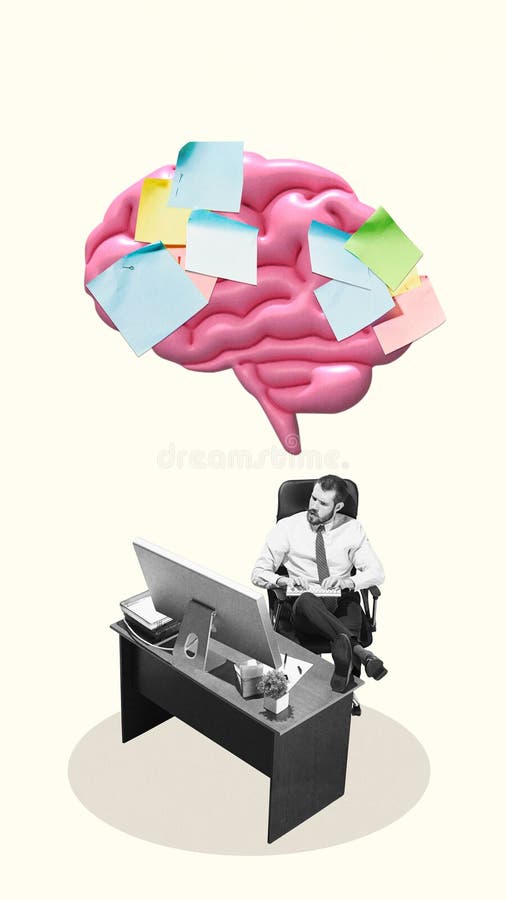
The myth of multitasking and brain overload. Image: Public Domain.
“We kept looking for what they’re better at, and we didn’t find it,” said Eyal Ophir, the study’s lead author. The researchers split students into two groups — those who constantly juggled multiple screens and those who didn’t — and put them through three different challenges. The heavy multitaskers failed every single one.
First, the researchers showed participants images with distracting blue rectangles surrounding the important red ones. The multitaskers couldn’t ignore the distractions. “They’re suckers for irrelevancy,” said communication professor Clifford Nass. “Everything distracts them.”
Then came the memory test. Students watched sequences of letters flash on screen and had to spot repeats. The multitaskers started strong but got worse as the test went on. “They kept seeing more letters and had difficulty keeping them sorted in their brains,” Nass explained.
Surely these digital ninjas would crush the final test about switching between tasks? Nope. When asked to rapidly alternate between classifying numbers and letters, they choked. “They couldn’t help thinking about the task they weren’t doing,” Ophir said. “They can’t keep things separate in their minds.”
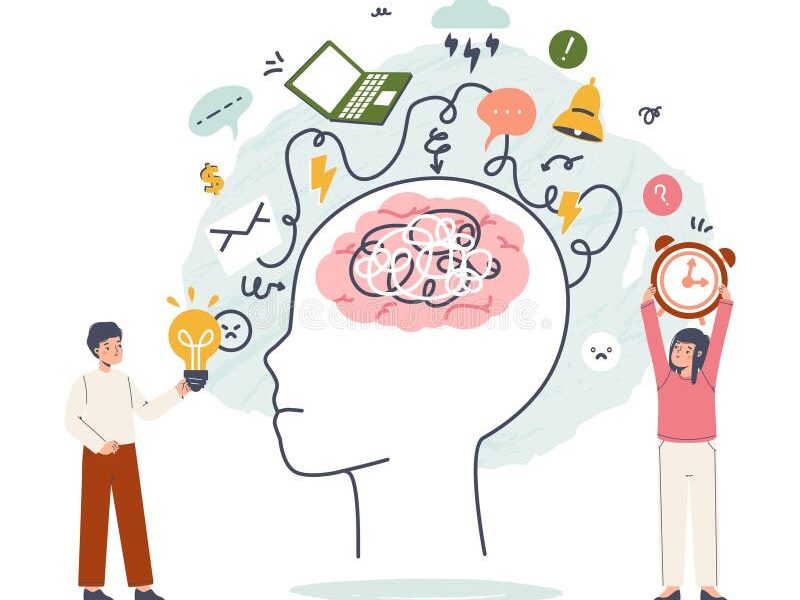
So what’s actually happening when we “multitask”? Our brains are doing something psychologists call “task-switching” — and it’s exhausting. Every time you bounce from your phone to your laptop to a conversation, your brain has to shut down one set of mental rules and boot up another. Researchers call these “switch costs,” and they eat up your focus and introduce mistakes.
Brain scans confirm this isn’t efficient. When you switch tasks, specific brain regions light up like a Christmas tree as your mind struggles to change gears. You’re not processing two things at once; you’re just doing one thing badly, then another thing badly, then switching back.
The damage adds up. Studies suggest multitasking can tank your productivity by 40% and spike your error rate by 20% (Resilience Institute, 2025). There’s even a tiny group of “supertaskers” — about 2% of people — who can actually handle multiple demanding tasks. But good luck figuring out if you’re one of them without formal testing.
The truth is, your brain works best when it does one thing at a time. That doesn’t mean you need monk-like silence and zero interruptions. But it does mean batching similar tasks, turning off notifications, and giving yourself permission to focus. As the Stanford team put it: “By doing less, you might accomplish more.”
Bibliography
American Psychological Association. (2023). Multitasking: Switching costs. https://www.apa.org/topics/research/multitasking
Jamadar, S., Thienel, R., & Karayanidis, F. (2010). Task switching. Cerebral Cortex. https://pmc.ncbi.nlm.nih.gov/articles/PMC7075496/
Ophir, E., Nass, C., & Wagner, A. D. (2009). Cognitive control in media multitaskers. Proceedings of the National Academy of Sciences, 106(37), 15583-15587. https://www.pnas.org/doi/10.1073/pnas.0903620106
Resilience Institute. (2025). The myth of multitasking: How focus unlocks your full potential. https://resiliencei.com/blog/the-myth-of-multitasking-how-focus-unlocks-your-full-potential/
Rubinstein, J. S., Meyer, D. E., & Evans, J. E. (2001). Executive control of cognitive processes in task switching. Journal of Experimental Psychology: Human Perception and Performance, 27(4), 763-797. https://psycnet.apa.org/record/2001-05358-001
Stanford University. (2009, Aug. 24). Media multitaskers pay mental price, Stanford study shows. Stanford News. https://news.stanford.edu/stories/2009/08/multitask-research-study-082409