The Unsettling Truth About Earworms (And How to Kill Them)
David DiezFebruary 25, 20265 min read1 comment
It begins with a snippet — perhaps the chorus of a pop song you heard in a grocery store, or the jingle from a commercial you didn’t even realize you were watching. Within hours, it has colonized your consciousness, playing on an infinite loop in your mind’s ear. You try to focus on work, but the melody intrudes. You attempt to read, but the lyrics surface. You lie in bed at night, and there it is, repeating with mechanical precision. You have an earworm, and your brain is refusing to let it go.
Up to 98% of the Western population experiences these involuntary musical intrusions, according to research published in the Journal of Anxiety Disorders. The phenomenon, technically called involuntary musical imagery or stuck song syndrome, was first named “earworm” in 1979 by German psychiatrist Cornelius Eckert, drawing from the German Ohrwurm — literally “ear worm.” Harvard Medical School psychiatrist David Silbersweig explained in a 2021 interview that these loops typically last about 20 seconds and represent automatic activations of musical memory networks in the brain.
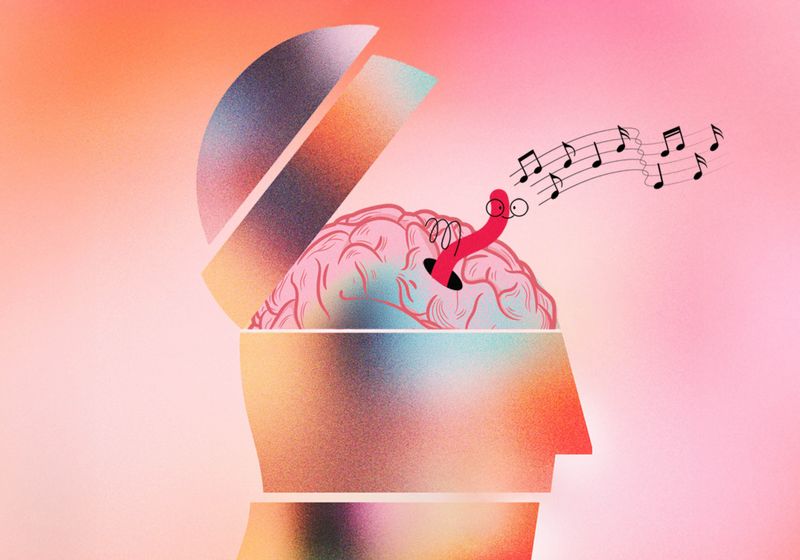
Illustration of the “earworm” phenomenon. Image: Public Domain via The Scientist.
Neuroscience research using functional magnetic resonance imaging has mapped the brain regions responsible for this mental torture. When an earworm activates, it engages the auditory cortex in the temporal lobe, which supports musical perception, along with deep temporal-lobe structures like the hippocampus that handle memory encoding and retrieval. The phonological loop — the brain’s mental scratchpad for holding auditory information — becomes stuck, while emotional regions including the amygdala and nucleus accumbens add salience and reward value that make the loop difficult to ignore. Silbersweig noted that these networks evolved to help humans remember oral histories and musical associations, making them particularly sticky when activated involuntarily.
Certain musical characteristics make songs more likely to become earworms. Research published in Psychonomic Bulletin & Review in 2020 found that repetitive melodies, longer note durations, smaller intervals between notes, and emotional associations all increase earworm potential. The songs don’t need to be enjoyable — in fact, people often report being tormented by music they actively dislike. The brain latches onto structural features of the melody rather than aesthetic preferences.
For most people, earworms are benign annoyances that resolve within hours or days. But for some, they become genuinely debilitating. A 2014 comprehensive review in the Journal of Anxiety Disorders examined cases where earworms developed into musical obsessions — persistent, distressing intrusions that interfered with sleep, concentration, and daily functioning. These severe cases often co-occurred with obsessive-compulsive disorder, where the earworms represented a subtype of obsessive intrusive thoughts. The review documented cases of patients who experienced near-constant musical imagery for months, causing severe insomnia and functional impairment.
The mechanism behind earworms involves what psychologist Daniel Wegner termed “ironic process theory” — the more you try to suppress a thought, the more persistently it returns. A 2014 study in PLOS ONE found that attempting to block an earworm often increases its intensity, creating a vicious cycle of suppression and rebound. The brain’s attempt to monitor whether the song is gone ironically keeps it present.
So how do you kill an earworm? Research suggests several evidence-based strategies. The PLOS ONE study found that engaging with the earworm — singing it aloud or listening to the complete song — can help the brain achieve closure and release the loop. Physical distraction also proves effective: chewing gum, working on puzzles, or engaging in conversation occupies the phonological loop and motor cortex, making them unavailable for musical imagery. Some researchers advocate mindfulness approaches — accepting the earworm without judgment and allowing it to fade naturally rather than fighting it.
For clinical cases of musical obsession, cognitive behavioral therapy offers the most effective treatment. Exposure and response prevention, a form of CBT, involves deliberately exposing patients to the musical imagery while preventing their usual compulsive responses, eventually reducing the anxiety driving the obsessions. Selective serotonin reuptake inhibitors and clomipramine, medications typically used for OCD, have shown effectiveness in severe cases when combined with psychotherapy.
The persistence of earworms reveals something profound about human cognition: we do not fully control our own minds. The same neural machinery that allows us to remember beloved songs, learn language, and preserve cultural knowledge can turn against us, trapping us in involuntary loops of sound. The brain evolved to remember music because music helped our ancestors survive — to remember oral histories, coordinate group activities, and communicate emotion. But evolution did not anticipate Spotify, jingles, and infinite musical repetition. In a world saturated with catchy melodies, our ancient neural circuits sometimes malfunction, and we find ourselves haunted by our own memories.
Bibliography
Liikkanen, L. A., Jakubowski, K., & Stewart, L. (2020). Involuntary musical imagery as a component of ordinary music cognition: A review of empirical evidence. Psychonomic Bulletin & Review, 27(6), 1155-1177. https://pubmed.ncbi.nlm.nih.gov/32583211/
Taylor, S., McKay, D., Miguel, E. C., et al. (2014). Musical obsessions: A comprehensive review of neglected clinical phenomena. Journal of Anxiety Disorders, 28(6), 580-589. https://pmc.ncbi.nlm.nih.gov/articles/PMC4723199/
In March 1964, 28-year-old Kitty Genovese was murdered outside her apartment building in Queens, New York. According to initial reports, 38 neighbors witnessed the attack...






x