
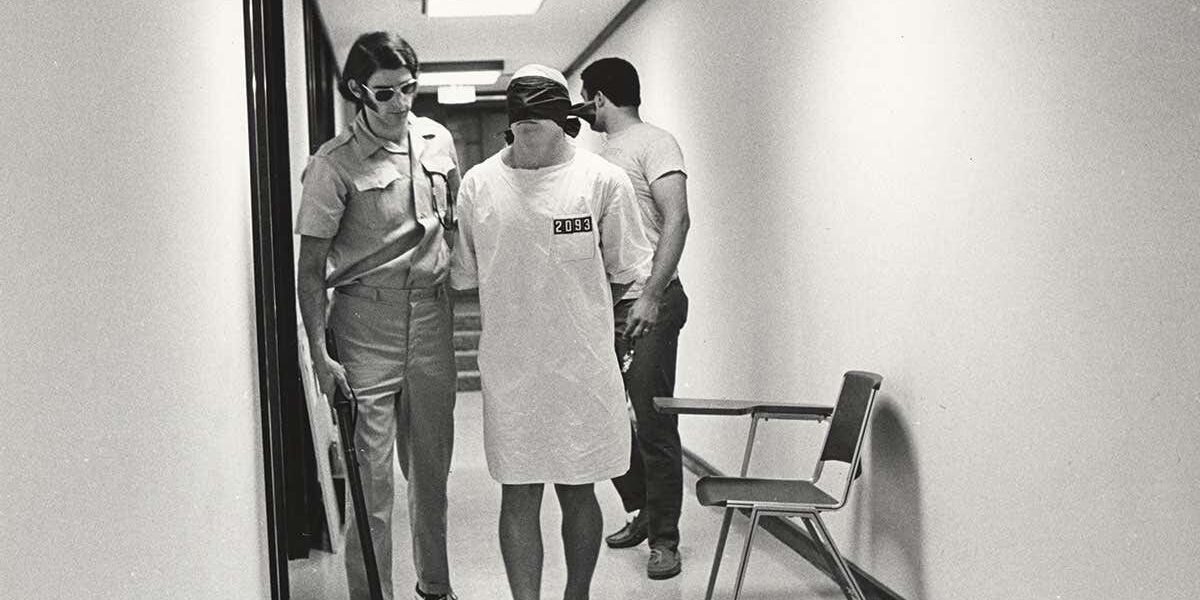
The official story, popularized in psychology textbooks and TED talks, suggests the experiment revealed how easily ordinary people become tyrants when given authority. But a closer examination of the archival evidence, methodology, and ethical violations reveals something more disturbing: the study didn’t just go wrong — it was designed to go wrong, and its findings say more about experimental manipulation than human nature.
Once selected, the “guards” received explicit instructions about how to behave. Contrary to Zimbardo’s claims that they spontaneously developed brutal behaviors, archival audio recordings reveal David Jaffe, the undergraduate student serving as “warden,” explicitly told guards they needed to be “tough” and create “a sense of powerlessness” among prisoners. In a taped orientation session, Jaffe instructed: “You can create in the prisoners a sense of boredom, a sense of fear, a sense of frustration. You can create in them a sense of arbitrary control.” Simply Psychology reported these explicit instructions in its 2025 analysis of the experiment.
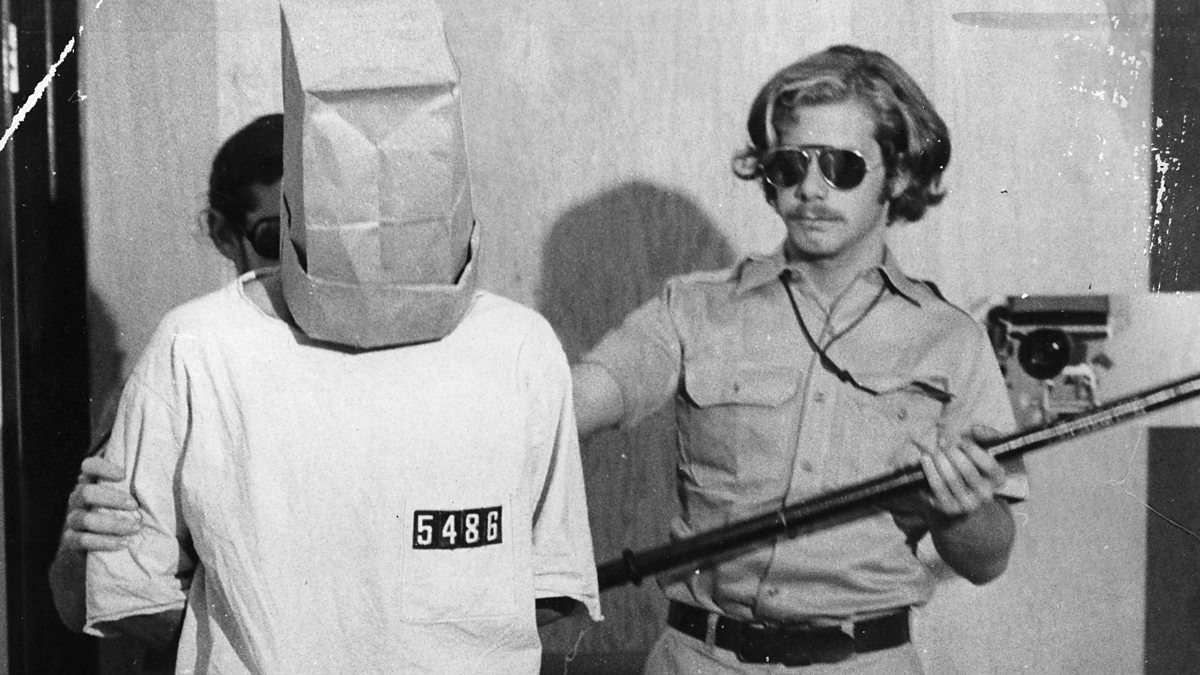
The guards didn’t need much encouragement. By the second day, they were forcing prisoners to strip naked, sleep-depriving them through hourly “counts,” and making them clean toilets with bare hands. Prisoner Clay Ramsey, designated #416, went on a hunger strike to protest conditions. Guards responded by placing him in solitary confinement — a small closet — and telling other prisoners he was “a bad prisoner.” They then forced the remaining prisoners to chant repeatedly: “Prisoner #416 is a bad prisoner. Because of what Prisoner #416 did, my cell is a mess.” Simply Psychology documented these abuses in its comprehensive review.
Zimbardo himself became consumed by his role as “prison superintendent.” He later admitted that he lost all objectivity, failing to recognize the escalating abuse because he had internalized his authority position. The experiment ended only when Christina Maslach, a graduate student (and later Zimbardo’s wife), visited on the sixth day and was horrified by what she witnessed. She confronted Zimbardo directly, telling him, “It’s terrible what you are doing to these boys!” Her intervention finally snapped him out of his role-playing trance, and he terminated the study that evening. Simply Psychology reported these details in its 2025 analysis.
The ethical violations were staggering. Participants had not given fully informed consent because Zimbardo himself didn’t know what would happen — though this unpredictability doesn’t excuse the failure to protect subjects from foreseeable harm. The “arrests” at participants’ homes came as genuine surprises, constituting psychological manipulation before the experiment even began. Most critically, the consent form stated participants could only leave for “reasons of health deemed adequate by the medical advisers” — a clause that directly contradicted ethical principles of voluntary withdrawal. Simply Psychology highlighted these consent violations in its review.
The scientific value remains questionable. The sample size was tiny, the methodology was compromised by demand characteristics and explicit coaching, and the results have never been replicated. A 2002 British replication attempt by Stephen Reicher and Alex Haslam, broadcast as the BBC Prison Study, produced radically different results — guards and prisoners developed cooperative relationships rather than tyrannical ones, suggesting that social identity and group dynamics matter more than absolute power.
The experiment’s true lesson may be about the ethics of scientific research itself. When investigators become invested in proving a hypothesis, when they fail to protect vulnerable participants, when they confuse dramatic results with valid findings — science becomes indistinguishable from spectacle. The real prisoners in Zimbardo’s basement were not the college students playing roles, but the boundaries of ethical research itself, which were sacrificed to create a compelling narrative about the darkness of human nature.
Bibliography
Le Texier, T. (2018). Histoire d’un mensonge: Enquête sur l’expérience de Stanford. La Découverte.
Reicher, S., & Haslam, S. A. (2006). Rethinking the psychology of tyranny: The BBC prison study. British Journal of Social Psychology, 45(1), 1-40.
Simply Psychology. (2025). Stanford Prison Experiment. https://www.simplypsychology.org/zimbardo.html