
In 1956, the Brazilian government commissioned a young geneticist named Warwick Estevam Kerr to solve a problem that had been quietly frustrating the country’s farmers for decades. European honeybees, introduced to South America by Portuguese colonizers in 1839, were simply not built for the tropics. They were lethargic in the heat, unproductive in the humidity, and largely indifferent to the abundance of flowering plants surrounding them. Brazil, with one of the most biodiverse agricultural landscapes on Earth, ranked forty-seventh in world honey production. Kerr, who had trained under the legendary geneticist Theodosius Dobzhansky at Columbia University and was already regarded as one of the most gifted entomologists in Latin America, was asked to fix this.
He flew to Tanzania and came back with 173 African queen bees.¹
The Logic of the Experiment
Kerr’s reasoning was, by the scientific standards of the day, sound. The African honeybee (Apis mellifera scutellata) was phenomenally productive in tropical conditions — industrious, disease-resistant, early to rise, and adapted by millennia of evolution to exactly the kind of climate that had defeated its European cousins. It was also, Kerr acknowledged, significantly more aggressive. African honeybees had evolved in an environment patrolled by honey badgers, army ants, and human foragers; their survival had depended on an extreme defensiveness that European bees, with their comparatively gentler predator landscape, had never needed to develop.
Kerr’s plan was to cross-breed the African queens with European drones, then selectively breed out the aggression over successive generations while retaining the productivity. He was not, despite what would later be claimed about him, trying to create a weapon. He was trying to make a better bee for Brazil’s farmers.
Fewer than a third of the 173 African queens survived the journey from Tanzania. Of those that remained, Kerr selected 35 for his breeding program at an apiary near Rio Claro in São Paulo state. The hives were fitted with queen excluders — wire screens designed to allow worker bees to pass freely while preventing the larger queen bees and drones from leaving and mating with the surrounding wild bee population. The experiment was proceeding carefully, if slowly.
Then, in October 1957, a visiting beekeeper arrived at the apiary.²
The Accident
The visiting beekeeper, whose name has been variously reported but never definitively established in the primary record, noticed that the queen excluders were obstructing the movement of worker bees — a genuine problem that any experienced beekeeper might have flagged. With the best of intentions and no awareness of the specific experimental protocols Kerr had established, he removed the screens.
Twenty-six colonies of Africanized bees flew out into the Brazilian rainforest.
Kerr later said he had initially hoped the escaped swarms would quickly die off or breed with feral European bees, diluting their aggression into the larger population. This did not happen. The African genetics proved dominant, and the Africanized hybrid — combining the productivity of the African bee with its outsized defensiveness — proved extraordinarily well-suited to the South American environment. The colonies didn’t die. They thrived, swarmed, and spread.³
The Swarm Moves North
What followed over the next three decades was one of the most consequential accidental biological introductions in modern history. Moving at an average of 200 to 300 miles per year, the Africanized honeybee spread through Brazil, then into neighboring countries, then northward through Central America. They entered the United States at the Texas border in October 1990, were confirmed in Arizona and New Mexico in 1993, and reached California in 1994.⁴
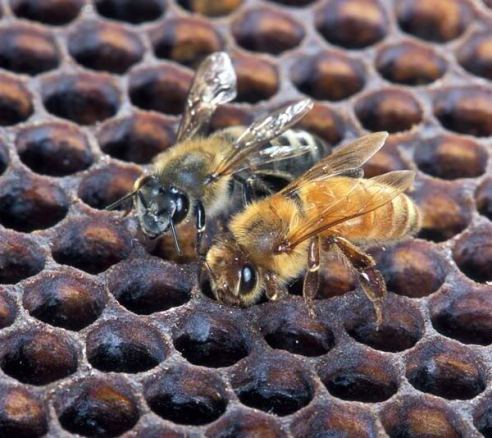
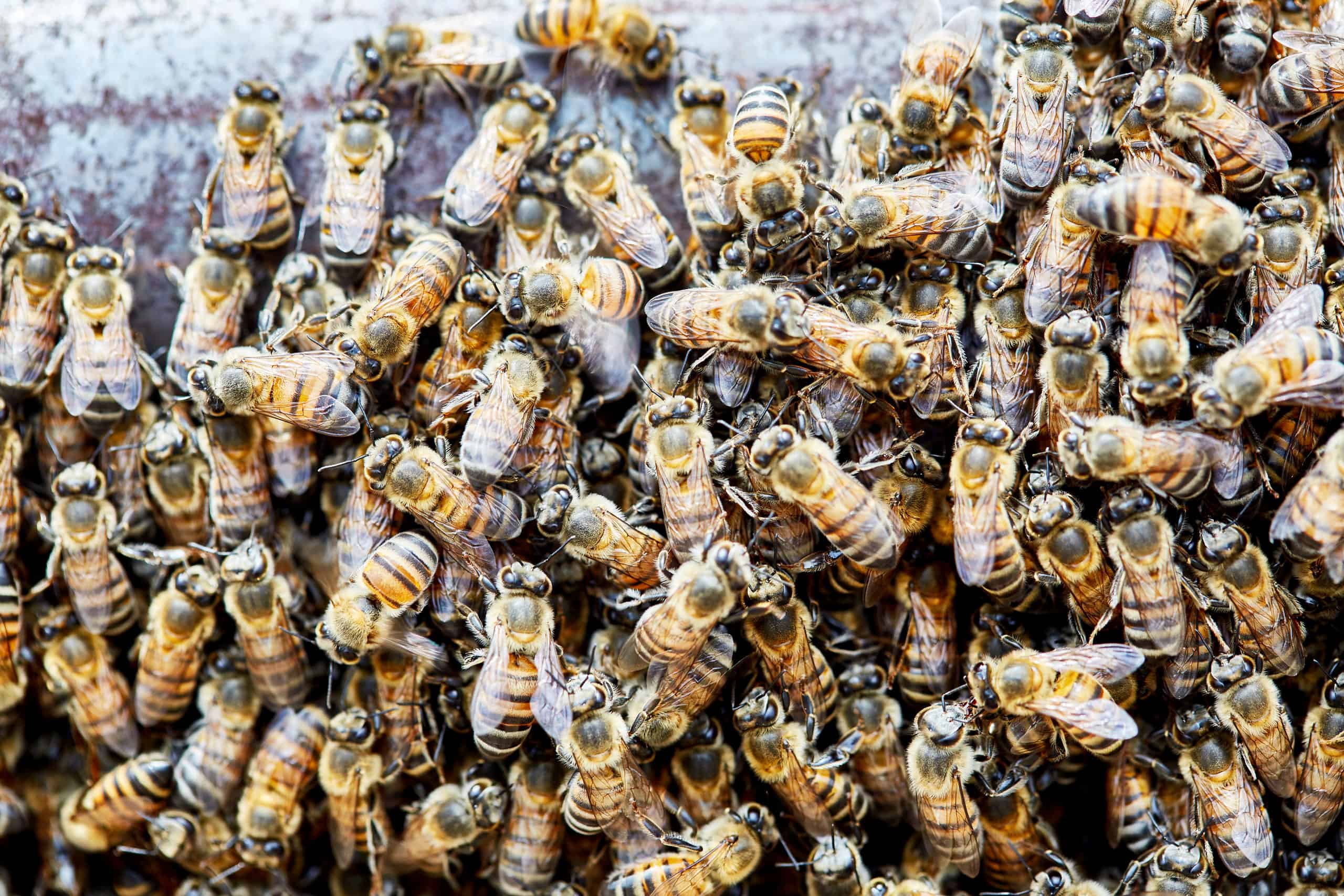
The behaviors that distinguished them from European bees were not, contrary to popular belief, a matter of venom potency — the venom of an Africanized bee is chemically identical to that of a European bee. What was different was everything else. When threatened, an Africanized colony mobilizes a far greater proportion of its members to defend the hive. European colonies send roughly ten percent of their workers out in defense; Africanized colonies can empty the hive entirely, producing swarms of 300,000 to 800,000 bees. They respond to disturbances more quickly, pursue threats over greater distances — up to 400 meters, compared to a European bee’s 50 — and remain agitated far longer after an alarm pheromone has been released.⁵
As the peer-reviewed medical literature noted when the bees began entering the southern United States, it is not the individual sting that kills — it is the cumulative venom dose of hundreds or thousands of stings simultaneously, a situation that Africanized bees are uniquely capable of producing. An estimated 1,000 stings is a fatal dose for an average adult human. Africanized swarms routinely deliver that and more.⁶
What the “Killer Bee” Label Actually Meant
The story of the Africanized honeybee is also a story about how a scientific accident was weaponized for political purposes. By the early 1960s, Kerr had become an outspoken critic of Brazil’s military dictatorship, which had seized power in 1964. He was imprisoned that year for fighting government corruption, and again in 1969 for publicly protesting after soldiers raped and tortured a nun who ran an orphanage in Ribeirão Preto. The military government, unable to silence or kill a scientist with Kerr’s international reputation, settled for destroying it.
Brazilian state media began portraying Kerr not as a geneticist who had suffered an accidental escape from an experiment, but as a rogue scientist who had deliberately created assassin bees. The “killer bee” label was born not primarily from science journalism but from the propaganda apparatus of a dictatorship looking for a way to discredit a man it couldn’t otherwise touch.⁷ The North American press, delighted by the phrase, adopted it enthusiastically.
The actual results of Kerr’s work were considerably more complicated than the label suggested. After the initial chaos of the escape, Brazilian beekeepers gradually learned to manage the new hybrid. By 1977, Brazil had crossed the 10,000-ton annual honey production threshold for the first time in its history. By the 1990s, it had risen from forty-seventh in the world to among the top ten producers. Most of the world’s organic honey now comes from South American Africanized bees.⁸ The bees that Kerr’s visiting beekeeper accidentally released from their hives were, in a perverse irony, exactly the productive tropical bee he had set out to create. They were simply also very, very dangerous.
The Man Behind the Bee
Warwick Kerr died on September 15, 2018, six days past his ninety-sixth birthday, having spent most of his adult life being blamed for what a careless visitor had done on an October afternoon in 1957. He was a founding member of multiple Brazilian genetics departments, a director of the National Institute for Research in the Amazon, and a foreign associate of the National Academy of Sciences of the United States. He published 620 scientific papers. He spent years in political imprisonment. He watched his life’s work become a global synonym for catastrophe.
He also, by any fair accounting, helped turn Brazil into one of the most significant honey-producing nations on Earth. The visiting beekeeper who removed the queen excluders is remembered by no one. The man who designed the experiment that the visiting beekeeper disrupted is remembered mostly for the disruption.
That is, perhaps, the most consistently unfair thing about accidents: they are remembered in the name of whoever was nearest when they happened.
Endnotes
¹ “Killer Bees Invade the United States,” https://www.ebsco.com/research-starters/history/killer-bees-invade-united-states; Natural History Museum (London), “Killer Bees: A Deadly Swarm,” https://www.nhm.ac.uk/discover/killer-bees-a-deadly-swarm.html.
² Natural History Museum (London), “Killer Bees: A Deadly Swarm,” https://www.nhm.ac.uk/discover/killer-bees-a-deadly-swarm.html; EBSCO Research Starters, “Killer Bees Invade the United States,” https://www.ebsco.com/research-starters/history/killer-bees-invade-united-states.
³ “Killer Bees Invade the United States”; University of California Riverside, Center for Invasive Species Research, “Africanized Honey Bee,” https://cisr.ucr.edu/invasive-species/africanized-honey-bee.
⁴ University of California Riverside, Center for Invasive Species Research, “Africanized Honey Bee”; USDA Agricultural Research Service, “USDA Map of Africanized Honey Bee Spread Updated,” https://www.ars.usda.gov/news-events/news/research-news/2007/usda-map-of-africanized-honey-bee-spread-updated/.
⁵ USDA ARS Carl Hayden Bee Research Center, “Africanized Honey Bees Overview,” https://www.ars.usda.gov/pacific-west-area/tucson-az/carl-hayden-bee-research-center/docs/africanized-honey-bees/africanized-honey-bees-overview/; Natural History Museum (London), “Killer Bees: A Deadly Swarm.”
⁶ M. J. Schumacher, J. O. Schmidt, N. B. Egen, and K. A. Dillon, “Biochemical Variability of Venoms from Individual European and Africanized Honeybees (Apis mellifera),” Journal of Allergy and Clinical Immunology 90, no. 1 (July 1992): 59–65, https://doi.org/10.1016/s0091-6749(06)80011-4; Justin O. Schmidt et al., “What Physicians Should Know About Africanized Honeybees,” Western Journal of Medicine 163, no. 6 (December 1995): 541–46, https://pmc.ncbi.nlm.nih.gov/articles/PMC1303260/.
⁷ “Killer Bees Invade the United States”; NC State University Extension, “Africanized Honey Bees: Where Are They Now, and When Will They Arrive in North Carolina?” https://content.ces.ncsu.edu/africanized-honey-bees-where-are-they-now-and-when-will-they-arrive-in-north-carolina.
⁸ NC State University Extension, “Africanized Honey Bees: Where Are They Now”; University of California Riverside, Center for Invasive Species Research, “Africanized Honey Bee.”