

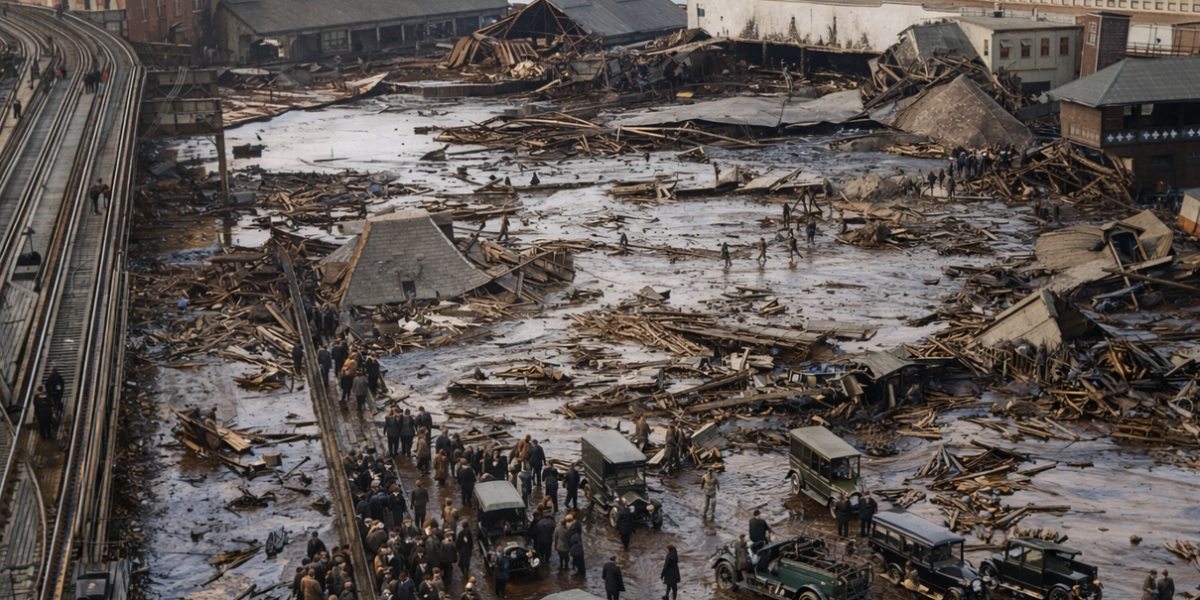
Shortly after 12:30 in the afternoon on January 15, 1919, the residents of Boston’s North End heard a sound unlike anything they could immediately place: a deep metallic groan, then a series of rapid-fire cracks like rifle shots, then something between a roar and a hiss. Children playing near the waterfront looked up. Workers on Commercial Street stopped what they were doing.
Then the wave hit.
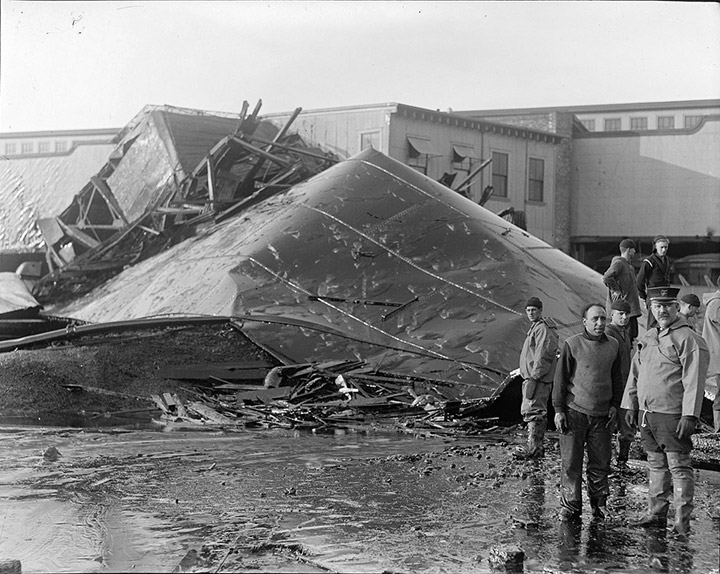
A 50-foot steel tank holding 2.3 million gallons of molasses had just catastrophically failed, releasing its entire contents in seconds. The wave that rolled through the North End was 25 feet high at its peak and, according to contemporaneous accounts confirmed by later scientific analysis, moving at approximately 35 miles per hour. It demolished a firehouse, tore an elevated train structure from its foundations, hurled a freight truck into Boston Harbor, snapped telegraph poles like matchsticks, and swept people, horses, and vehicles into a roiling brown mass from which many of them would never emerge. Before the day was over, 21 people were dead and 150 more were injured. The cleanup would take weeks. The smell of molasses, locals would report, haunted the North End on hot summer days for decades.¹
A Tank Built to Fail
The tank at 529 Commercial Street was constructed in 1915 by the United States Industrial Alcohol Company (USIA), which operated it through a subsidiary called Purity Distilling. The timing was not coincidental. World War I had created an enormous demand for industrial alcohol, which was used in the manufacture of munitions — specifically, cordite, the smokeless propellant used in artillery shells. Molasses, fermented and distilled, was the cheapest available feedstock. USIA brought it in by ship from the Caribbean, stored it in the Commercial Street tank, and piped it to a distillery in Cambridge.
The tank was enormous — 50 feet tall and 90 feet in diameter, capable of holding up to 2.5 million gallons — and it was built with haste that bordered on recklessness. Structural engineers who later examined the ruins reported that the walls were far too thin for a vessel of that size and the steel itself was of substandard quality, its carbon content making it brittle rather than ductile under stress. The tank had never been properly tested: according to Stephen Puleo, whose 2004 book Dark Tide is the definitive account of the disaster, USIA had filled the tank with water only up to a foot to check for leaks — nowhere near the 50-foot capacity at which it would be operated.² Workers in the neighborhood noticed from the start that it seeped. Children scraped the sweet ooze from its rivets with sticks and carried it home on their fingers. When neighbors complained to USIA about the leaking, the company’s response was to paint the tank brown, to disguise the molasses against the steel.
USIA treasurer Arthur Jell, who had approved the tank’s construction and supervised its operation, had no engineering credentials whatsoever.³
The Physics of Sweet Death
What made the flood so lethal was a combination of factors that, taken individually, might each have been survivable — but together proved catastrophic.
The immediate cause of the tank’s failure remains somewhat contested, but the leading explanation involves a deadly interaction between temperature and physics. On January 13, two days before the disaster, a fresh Caribbean shipment had topped the tank nearly to capacity. The new molasses was warm from its journey; the older molasses already in the tank was cold from a Boston winter. Two days later, the temperature in the North End climbed above 40 degrees Fahrenheit — unseasonably mild — after days of hard cold. The thermal expansion of the warming molasses, combined with the structural inadequacy of the tank, likely provided the final trigger.⁴
Once the tank burst, the physics of what followed were not those of ordinary water. Molasses is a non-Newtonian fluid — meaning its viscosity changes depending on the forces applied to it. At the moment of the collapse, the enormous pressure caused it to behave like a fluid of relatively low viscosity, capable of moving at extraordinary speed. “A wave of molasses is even more devastating than a typical tsunami,” Scientific American noted in a 2013 analysis. “The dense wall of syrup surging from its collapsed tank initially moved fast enough to sweep people up and demolish buildings, only to settle into a more gelatinous state that kept people trapped.”⁵
This second phase — the settling — was, if anything, more horrifying than the initial wave. As the molasses cooled in the January air, it thickened rapidly back toward its natural viscous state, essentially cementing those caught within it in place. Nicole Sharp, an aerospace engineer who led a team of Harvard researchers in a 2016 scientific analysis of the flood, concluded that the cold temperatures dramatically complicated rescue efforts. By the time first responders arrived — police, firefighters, sailors from the Navy training vessel USS Nantucket, and eventually Red Cross workers — they were attempting to pull survivors out of what was effectively hardening glue.⁶ Horses trapped in the flood struggled to free themselves and drowned. At least one victim died of asphyxiation hours after the initial wave, when rescuers could not reach him in time.
The Boston Post reporter who arrived on scene captured what the witnesses were seeing: “Molasses, waist deep, covered the street and swirled and bubbled about the wreckage. Here and there struggled a form — whether it was animal or human being was impossible to tell. Only an upheaval, a thrashing about in the sticky mass, showed where any life was.”⁷
Anarchists, Lawyers, and Accountability
USIA’s first instinct, in the disaster’s immediate aftermath, was to blame someone else. The company pointed to anarchist bombers — not an implausible suggestion in January 1919, when the country was convulsed by the Red Scare and actual anarchist mail bombs were a documented phenomenon. The company’s claim was that a bomb had detonated inside or near the tank, causing the rupture.
The theory did not survive scrutiny. More than 100 lawsuits were consolidated into a single proceeding before a court-appointed auditor, Hugh W. Ogden, who spent the next six years hearing testimony from over 3,000 witnesses and reviewing 20,000 pages of evidence — one of the largest and most complex legal proceedings in Massachusetts history to that point. In 1925, Ogden ruled decisively that the disaster had been caused by structural defects in the tank and negligence on USIA’s part. The company had built an inadequate vessel, failed to test it properly, ignored warnings about its condition, and employed an unqualified man to oversee it. USIA was ordered to pay $628,000 in damages — approximately $10 million in today’s currency.⁸
The case had ramifications far beyond the courtroom. As Puleo documents, the disaster and its legal aftermath became a catalyst for engineering reform across the country. In the years following the ruling, states began requiring that construction plans for major structures be reviewed and certified by licensed professional engineers before building permits could be issued. The modern framework of structural engineering oversight — which today governs everything from bridges to stadiums to the glass towers of downtown Boston — traces a direct line back to a leaking tank in the North End.⁹
A City That Smelled of Molasses
The cleanup of Commercial Street took weeks. Workers discovered that ordinary water barely made a dent in the dried molasses. Eventually, firefighters began pumping saltwater directly from Boston Harbor, which proved more effective at breaking down the syrup. Even then, as the molasses was scrubbed from the streets and the debris of demolished buildings was carted away, the harbor itself ran brown. Boston’s newspapers reported that the waters near the waterfront remained stained until summer.
More than 300 workers ultimately converged on the disaster site. The fire station whose building had been destroyed — Engine 31 — relocated temporarily while its house was rebuilt. The elevated railway line was repaired. The bodies of the 21 dead, which had ranged in age from ten-year-old Pasquale Iantosca, who had been gathering firewood near the tank with friends when it burst, to 73-year-old laborer John Seeber, were recovered and identified.¹⁰ USIA never rebuilt the tank.
Today, a small bronze plaque at the entrance to Puopolo Park — installed by the Bostonian Society — marks the site. It reads, in part: “On January 15, 1919, a molasses tank at 529 Commercial Street exploded under pressure, killing 21 people. A 40-foot wave of molasses buckled the elevated railroad tracks, crushed buildings, and inundated the neighborhood.” It is a modest monument for a disaster of this scale, but the North End has preserved the memory in its own way. Ask an old-timer in the neighborhood about the flood, and some of them will tell you — with complete seriousness — that on the hottest days of a Boston summer, you can still catch a faint sweet smell drifting off the pavement near Commercial Street.
Whether that is true or simply the kind of story a neighborhood tells itself about its own wounds, it is not really the point. What the Great Molasses Flood left behind was not just the smell. It left a legal framework, an engineering standard, and the uncomfortable knowledge that the difference between corporate corner-cutting and mass death can be very thin — in this case, about as thin as the underbuilt walls of a 50-foot steel tank painted brown to hide the cracks.
Endnotes
¹ The death toll, injury count, and key physical details of the wave — height, speed, and scope of destruction — are documented in Stephen Puleo, Dark Tide: The Great Boston Molasses Flood of 1919 (Boston: Beacon Press, 2004), 1–9, and confirmed in “Great Molasses Flood,” Encyclopaedia Britannica, last updated January 8, 2026, https://www.britannica.com/topic/Great-Molasses-Flood. The 35 mph wave speed figure originates in the trial record and is confirmed in Nicole Sharp, Jordan Kennedy, and Shmuel Rubinstein, “In a Sea of Sticky Molasses: The Physics of the Boston Molasses Flood,” paper presented at the 69th Annual Meeting of the American Physical Society Division of Fluid Dynamics, Portland, Oregon, November 21, 2016, abstract ID BAPS.2016.DFD.L27.8, https://meetings.aps.org/Meeting/DFD16/Session/L27.8.
² Puleo, Dark Tide, 44–50. The water-fill test and the one-foot water level are described in Puleo’s account of the construction and testing history, drawn from the trial testimony. The carbon content problem with the steel is documented in Lauralice de Campos Franceschini Canale, George E. Totten, and Rafael A. Mesquita, eds., Failure Analysis of Heat Treated Steel Components (Materials Park, OH: ASM International, 2008), 57, cited in the U.S. Studies Online analysis of the disaster.
³ Puleo, Dark Tide, 52–55. Arthur Jell’s lack of engineering credentials is established in the trial record, Dorr v. United States Industrial Alcohol (Boston: Social Law Library, 1925), the auditor’s ruling that found USIA liable.
⁴ The temperature-and-thermal-expansion hypothesis is analyzed in Sharp, Kennedy, and Rubinstein, “In a Sea of Sticky Molasses,” and summarized in David Abel, “Harvard Scientists Dig Into the Fluid Dynamics Behind the Molasses Disaster,” Boston Globe, November 25, 2016, https://www.bostonglobe.com/metro/2016/11/24/harvard-scientists-dig-into-fluid-dynamics-behind-molasses-disaster/Lt5Ps31AEGGaTL3QiZqB7I/story.html. The fresh Caribbean shipment arriving two days before the disaster is confirmed in “Great Molasses Flood,” Encyclopaedia Britannica.
⁵ “A wave of molasses is even more devastating…” quoted in “Great Molasses Flood,” Scientific American, referenced in Wikipedia’s article on the disaster and attributed to a 2013 Scientific American analysis of molasses fluid dynamics. The non-Newtonian fluid behavior is explained in the APS abstract by Sharp, Kennedy, and Rubinstein: “Molasses is a viscoelastic fluid 1.5 times as dense as water with a viscosity roughly 4,000 times greater.”
⁶ Sharp, Kennedy, and Rubinstein, “In a Sea of Sticky Molasses,” APS 2016. Sharp’s conclusions about cold temperatures complicating rescue are also reported in Abel, Boston Globe, November 25, 2016: “A team of experts who studied the disaster concluded that cold temperatures quickly thickened the syrupy mess, which might have claimed few if any lives had it occurred in spring, summer, or fall.” Sharp is also quoted in “Why the Great Molasses Flood Was So Deadly,” History.com, updated August 2023, https://www.history.com/news/great-molasses-flood-science.
⁷ Boston Post, January 16, 1919, p. 1, “Huge Molasses Tank Explodes in North End; 11 Dead, 50 Hurt,” quoted in Puleo, Dark Tide, and in “Great Molasses Flood,” Wikipedia, citing the Boston Post archive. The original front page is held at the Boston Public Library, Microtext, call number AN2 .M4B666.
⁸ The legal proceedings, the auditor’s findings, and the damage award are documented in Dorr v. United States Industrial Alcohol (1925). For a detailed account of the trial, see Puleo, Dark Tide, 140–205. The 3,000-witness figure and the 20,000 pages of testimony are cited in “Why the Great Molasses Flood Was So Deadly,” History.com. The $628,000 settlement and its modern equivalent are also noted in Encyclopaedia Britannica.
⁹ Puleo, Dark Tide, 206–10. The disaster’s role in prompting state-level engineering certification laws is also noted in the Old North Church historical analysis of the flood: “Across the country, engineering certification laws came into effect and professional engineers registered all major structural plans before cities issued building permits.” Old North Church & Historic Site, “The 1919 Molasses Flood: Destruction, Immigration, and Active Citizenship in Boston’s North End,” January 20, 2023, https://www.oldnorth.com/blog/the-1919-molasses-flood/.
¹⁰ Pasquale Iantosca’s death and the identification of victims are documented in Puleo, Dark Tide, 7–8, and in the History.com account, which identifies the children gathering firewood near the tank from trial testimony. The Bostonian Society plaque text is reproduced in “Great Molasses Flood,” Wikipedia, and confirmed on-site.