
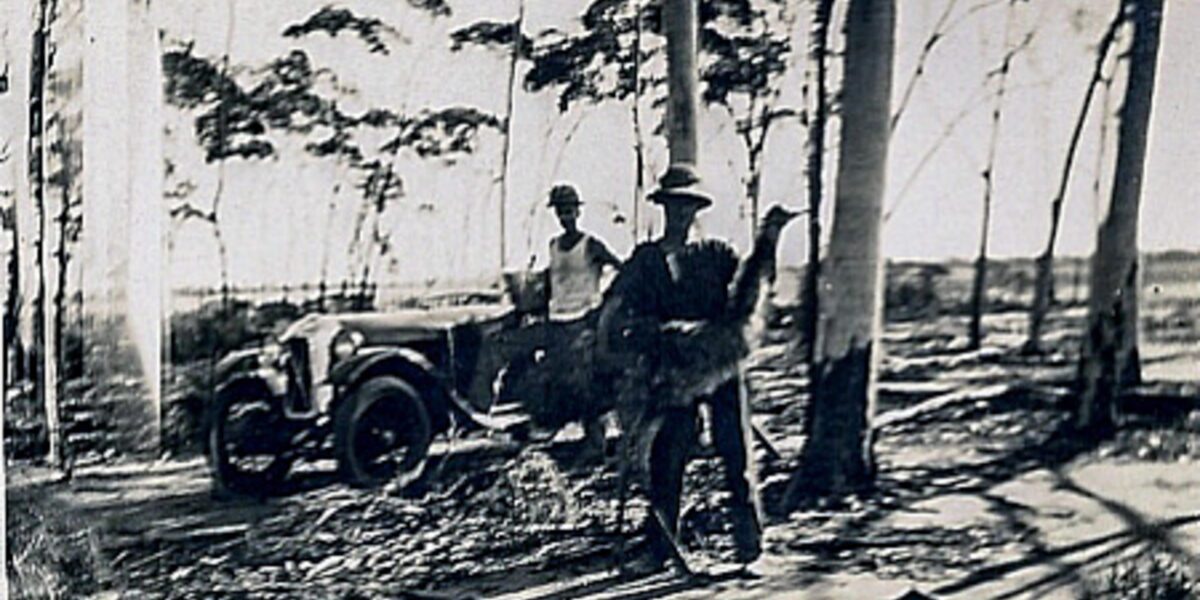
In November 1932, the Australian military deployed to the wheat fields of Western Australia with machine guns and a mission: exterminate 20,000 emus that were destroying crops. Six days later, they withdrew in defeat. The enemy had suffered minimal casualties, showed no fear, and seemed to mock every military tactic thrown at them. The Australian army had just lost a war against flightless birds.
The conflict that became known as the Great Emu War began with genuine desperation. Following World War I, the Australian government had granted land to thousands of returning veterans under a soldier settlement scheme. By 1932, these farmers faced catastrophe: wheat prices had collapsed during the Great Depression, drought had parched the land, and an estimated 20,000 emus had migrated inland from coastal regions, trampling fences and devouring crops. The birds, which can stand six feet tall and sprint at 30 miles per hour, found the cultivated farmland irresistible.
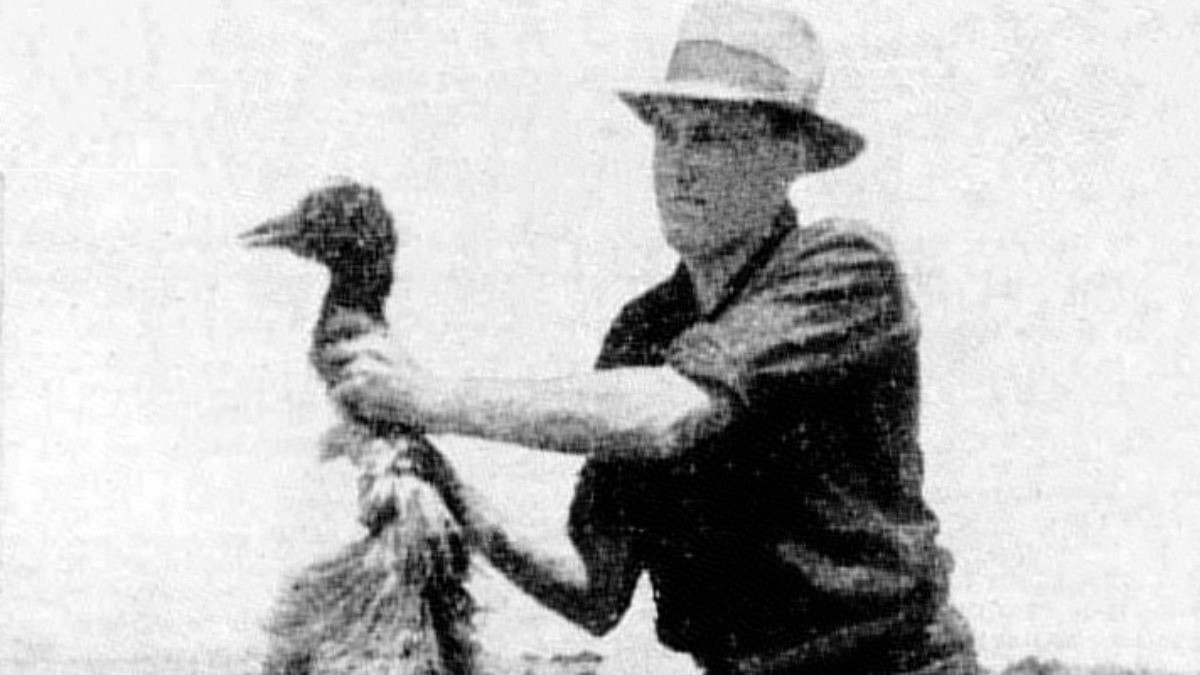
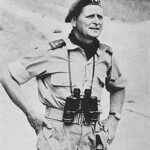
Ex-servicemen, struggling to survive economically, petitioned the federal government for aid. Their request was unprecedented: deploy the military with machine guns to cull the emu population. Defence Minister Sir George Pearce approved the operation, viewing it as both a training exercise and a public service. On November 2, 1932, Major G.P.W. Meredith of the Royal Australian Artillery arrived in the Campion district with two Lewis machine guns, 10,000 rounds of ammunition, and two soldiers.
The first encounter revealed the mismatch between military expectations and emu capabilities. When soldiers spotted approximately 50 emus, they set up their machine guns and opened fire. The birds scattered instantly, running in unpredictable patterns across the flat terrain. Only a handful fell. The soldiers tried mounting a machine gun on a truck for mobility, but the rough terrain made accurate firing impossible. The truck’s suspension failed, and the chase became farcical. Smithsonian Magazine documented these tactical failures in its historical analysis of the conflict.
Major Meredith’s reports to headquarters grew increasingly astonished. The emus demonstrated what he described as guerrilla warfare tactics: they posted sentries who alerted flocks to approaching danger, split into small groups to avoid concentrated fire, and absorbed multiple bullet wounds while continuing to run. In his official report, Meredith wrote that emus “could face machine guns with the invulnerability of tanks” and compared them to Zulu warriors who had defeated British forces decades earlier.
The media response compounded the military’s humiliation. Australian newspapers covered the “war” with gleeful mockery, while international outlets treated the story as comedy. A New South Wales Labor politician cynically asked if medals would be struck for participants; his federal counterpart replied that any medals should go to the emus, “who have won every round so far.” The Canberra Times reported on November 12, 1932 that the military had killed “300 in first duel” but noted the operation faced mounting criticism.
By November 8, just six days after deployment, the House of Representatives withdrew military support. The soldiers had fired approximately 2,500 rounds and killed perhaps 200 emus — a devastatingly inefficient ratio. Major Meredith estimated that ten bullets were required per bird killed, and the emu population remained essentially intact.
Political pressure from Western Australian farmers, combined with fears of a growing secessionist movement in the state, forced a second campaign beginning November 13. This time, soldiers employed ambush tactics near water sources and coordinated with local farmers who understood emu behavior. The extended operation through early December yielded better results — approximately 700 emus killed — but consumed all available ammunition. On December 2, 1932, the military withdrew permanently, leaving an estimated 19,000 emus still ravaging crops.
The aftermath proved as damaging as the defeat itself. In 1933, 66% of Western Australian voters supported secession from the Australian federation, though the British Parliament later ruled the petition invalid. Farmers who had hosted the military submitted bills for broken equipment and damaged property. One veteran, Daniel O’Leary, wrote to the Agricultural Bank refusing to pay his war debts, noting he should instead be compensated “for bashing out the brains of such of the enemy wounded as could be found after each engagement.”
The government eventually implemented more effective solutions. A bounty system introduced in 1934 allowed farmers and professional hunters to cull emus, resulting in over 57,000 deaths by 1948. Improved fencing proved more practical than machine guns. Between 1945 and 1960, an estimated 285,000 emus were killed in Western Australia alone, demonstrating that local knowledge and appropriate tools succeeded where military force had failed.
The Great Emu War endures in Australian folklore as both punchline and parable. A 2006 article in the Journal of Australian Studies by historian Murray Johnson examined how the conflict reflected broader tensions between the federal government and Western Australian settlers, arguing that the “war” represented a failed attempt to demonstrate federal power over a distant, discontented state. The episode demonstrates the limits of technological superiority against biological adaptation — the emus required no strategy, only speed, resilience, and instinct.
Australian ornithologist Dominic Serventy summarized the military failure with characteristic wit: “The machine-gunners’ dreams of point blank fire into serried masses of Emus were soon dissipated. The Emu command had evidently ordered guerrilla tactics, and its unwieldy army soon split up into innumerable small units that made use of the military equipment uneconomic. A crestfallen field force therefore withdrew from the combat area after about a month.” Cook and Jovanović quoted this assessment in their 2019 academic analysis of the conflict published in the Romanian Journal of Historical Studies.
Major Meredith’s final assessment captured the absurdity perfectly: “If we had a military division with the bullet-carrying capacity of these birds, it would face any army in the world.” In the end, the emus didn’t just win the battle. They won their place in history as the only birds to ever defeat a modern army — armed with nothing but long legs, thick hides, and the good sense to run faster than a government could think.
Cook, R. J., & Jovanović, S. M. (2019). The Emu strikes back: An inquiry into Australia’s peculiar military action of 1932. Romanian Journal of Historical Studies, 2(1), 1-11. https://doaj.org/article/b7ed3a4b7bb74d5685e22088c69a736b
Johnson, M. (2006). Feathered foes: Soldier settlers and WA’s ‘Emu War’ of 1932. Journal of Australian Studies, 30(88), 147-157.
https://recordsearch.naa.gov.au/scripts/AutoSearch.asp?O=I&Number=4350875
National Geographic. (n.d.). The bizarre story of when Australia went to war with emus—and lost. https://www.nationalgeographic.com/history/article/australian-emu-war-history
Papers Past. (1933, December 27). The emu war. The Star (Christchurch), Volume LXIV, Issue 955, Page 5. https://paperspast.natlib.govt.nz/newspapers/TS19331227.2.79
Smithsonian Magazine. (n.d.). When Australia went to war with its emus. https://www.smithsonianmag.com/history/australian-emu-war-history