The Fregoli Delusion: When You Believe Everyone Is the Same Person in Disguise
David DiezFebruary 25, 20265 min read0 comments
Imagine walking through a crowded grocery store and becoming convinced that every single person — the cashier, the stock boy, the elderly woman squeezing avocados — is actually your ex-girlfriend in disguise. Not just similar-looking people, but the same person, rapidly changing costumes and makeup to stalk you. This is the paranoid nightmare of Fregoli delusion, one of the rarest and most bizarre conditions in psychiatry.
First described in 1927 by French psychiatrists Courbon and Fail, Fregoli syndrome is named after Leopoldo Fregoli, an Italian actor famous for his ability to change costumes and identities rapidly on stage (National Center for Biotechnology Information, 2024). While its better-known cousin Capgras syndrome involves believing loved ones have been replaced by impostors, Fregoli operates in reverse: patients believe different people are actually a single familiar person in disguise.
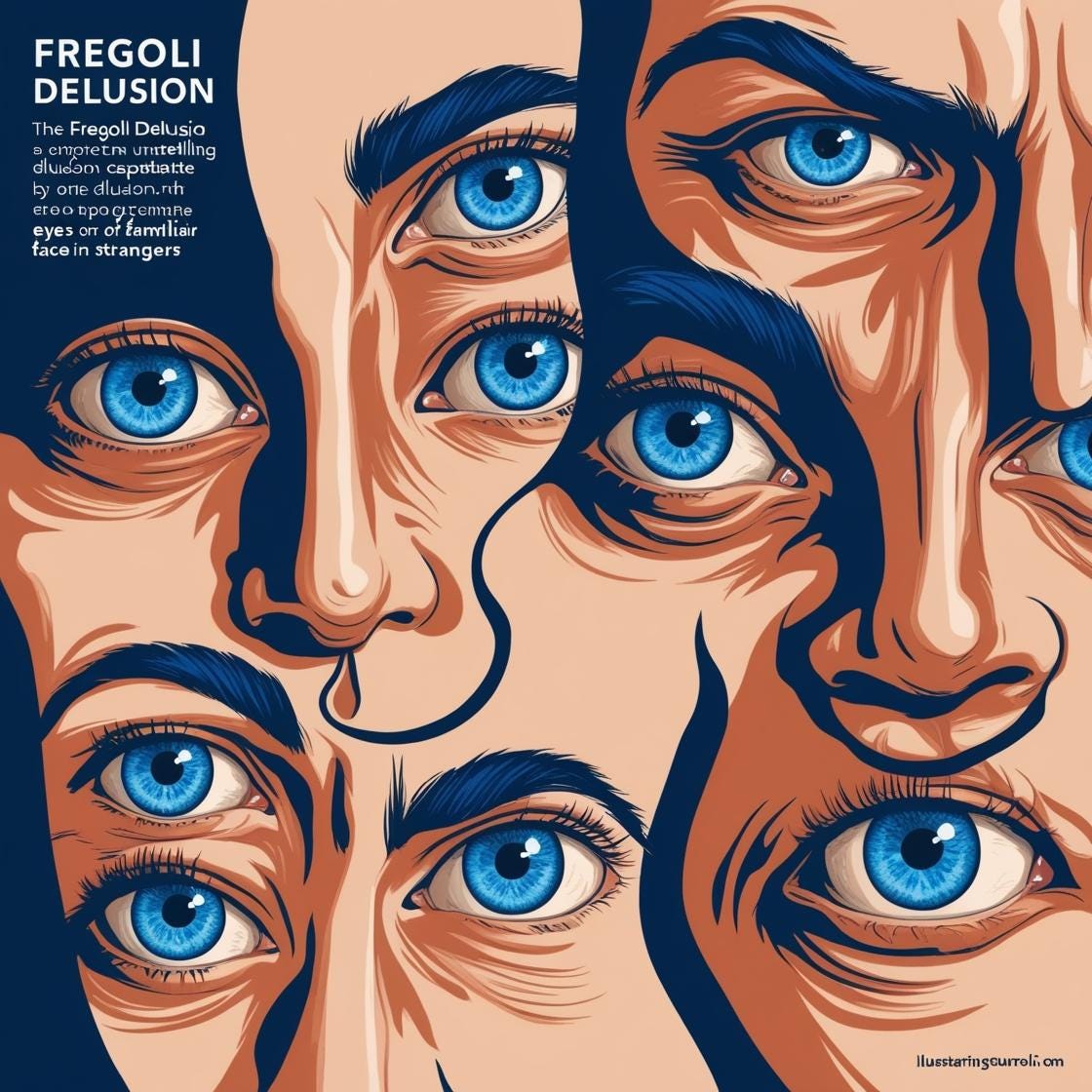
Conceptual illustration of the Fregoli Delusion. Image: Public Domain via Medium.
A landmark meta-analysis published in the Journal of Neuropsychiatry and Clinical Neurosciences examined 119 cases of Fregoli syndrome, finding that 52% involved primary psychosis (like schizophrenia) while 42% stemmed from secondary organic causes such as brain injury or dementia (Teixeira-Dias et al., 2023). The research revealed distinct patterns between these groups. Patients with secondary psychosis were significantly more likely to experience Fregoli symptoms during a first psychotic episode and showed more right hemisphere brain lesions (Teixeira-Dias et al., 2023).
The mechanism behind this delusion involves a fascinating neurological paradox. Unlike Capgras patients, who recognize faces but feel no emotional connection, Fregoli patients experience the opposite problem: they feel intense familiarity with strangers while maintaining accurate facial recognition. According to research published in the Indian Journal of Psychological Medicine, this represents “hyperfamiliarity” — an overactivity in the brain’s familiarity detection systems rather than a deficit (2025).
Neuroimaging studies point to specific brain regions responsible for this distorted reality. Lesions in the right frontal lobe — crucial for belief evaluation and reality monitoring — appear consistently in Fregoli cases. When this “cognitive control” region is compromised, patients cannot suppress the false belief that strangers are familiar, despite knowing their appearance differs (Academic Psychiatry, 2025). These lesions frequently connect to the retrosplenial cortex, which processes familiarity and self-referential information, creating a neurological perfect storm for misidentification (National Center for Biotechnology Information, 2024).
The delusion often carries a persecutory edge. A case report in Neuropsychiatric Disease and Treatment described a 21-year-old man who developed Fregoli syndrome after a romantic rejection on Facebook. He became convinced that every woman who contacted him online was actually his rejected love interest in disguise, using the same facial cream he used to transform her appearance (National Center for Biotechnology Information, 2012). Another recent case involved a 25-year-old male who believed friends, strangers, and professors were all disguising themselves to follow and harass him (Journal of Integrated Community Health, 2025).
Violence represents a serious risk. A comprehensive review in StatPearls noted that patients with delusional misidentification syndromes show high rates of aggression, with approximately half of violent acts involving weapons (National Center for Biotechnology Information, 2024). One forensic case involved a patient who fatally strangled his cellmate during a Fregoli episode, believing the victim was actually his persecutor in disguise (Indian Journal of Psychological Medicine, 2025).
Treatment remains challenging. The meta-analysis found that antipsychotic medications, particularly risperidone, show the most promise, though symptoms often prove refractory to treatment (Teixeira-Dias et al., 2023). Cognitive behavioral therapy focusing on reality testing and challenging misinterpretations has demonstrated success in some cases, particularly when combined with family psychoeducation (Journal of Integrated Community Health, 2025). Unlike Capgras syndrome, which often resolves when underlying depression is treated, Fregoli symptoms tend to persist and follow the course of the primary psychotic disorder.
What makes Fregoli particularly fascinating to neuroscientists is what it reveals about normal face processing. Every day, our brains effortlessly distinguish between “familiar” and “strange” — a computation so automatic we never notice it. Fregoli patients experience this filter breaking down, flooding them with false familiarity while leaving their visual recognition intact. As one review noted, the condition represents a “border zone between neurology and psychiatry,” where organic brain dysfunction produces symptoms once dismissed as purely psychological (PMC, 2023).
For those afflicted, the world becomes a stage of infinite masks, with one malevolent actor playing every role. The condition serves as a haunting reminder that our sense of who is familiar and who is strange depends on delicate neural circuits — circuits that, when disrupted, can transform strangers into stalkers and everyday encounters into paranoid nightmares.
Teixeira-Dias, M., et al. (2023). Neuropsychiatric Features of Fregoli Syndrome: An Individual Patient Meta-Analysis. Journal of Neuropsychiatry and Clinical Neurosciences, 35(2), 171-177. https://pubmed.ncbi.nlm.nih.gov/36172691/