
On a sweltering July morning in 1518, a woman stepped out of her home on a narrow cobblestone street in Strasbourg and began to dance. There was no music, no festival, no discernible reason. She just danced — wildly, compulsively, hour after hour — until she collapsed. Then she got up and danced again.
Her name was Frau Troffea, and she was only the beginning.
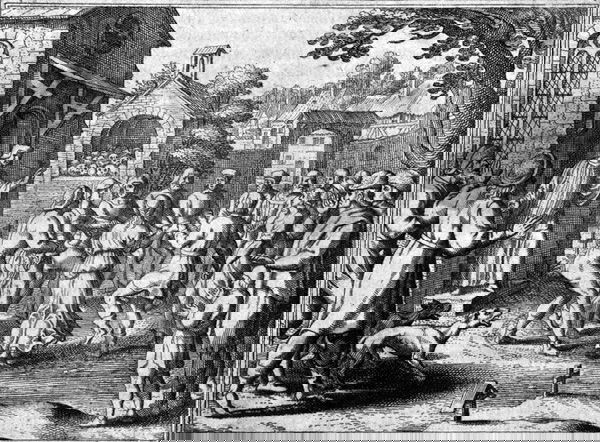
Within a week, roughly three dozen people had joined her. By August, the number had swelled to somewhere near four hundred. Some dancers reportedly collapsed from heart attacks, strokes, or sheer exhaustion. Contemporary accounts — physician notes, city council records, cathedral sermons, and local chronicles — all agree that the dancing was real, involuntary, and terrifying.¹ What they cannot agree on, even five centuries later, is why.
A City on the Edge
To understand how such a thing could happen, you have to understand what Strasbourg looked like in 1518. The city, then a free imperial city within the Holy Roman Empire, was in a state of sustained crisis. A string of failed harvests had pushed the poor toward starvation. Smallpox, syphilis, and plague stalked the streets. Religious anxiety was intensifying, with Martin Luther’s challenge to the Church barely a year old. “Strange heavenly portents of doom,” including a comet in 1492, had seeded apocalyptic fears that never quite faded.²
Into this environment of misery and dread stepped Frau Troffea — and, apparently, her terror spread.
Medical historian John Waller, whose 2009 book A Time to Dance, a Time to Die remains the definitive account of the episode, argues that the city’s authorities made things dramatically worse.³ Believing the affliction to be a medical condition caused by “hot blood,” local physicians prescribed more dancing as a cure — a tragic miscalculation. The city council ordered guild halls cleared and stages constructed in the horse market. Professional musicians were hired to play around the clock. The idea was that the stricken could dance themselves free of the fever. Instead, the spectacle drew more participants, and the death toll mounted.
The Curse of Saint Vitus
For the people of Strasbourg, the plague had a clear supernatural explanation: it was the curse of Saint Vitus. The cult of St. Vitus — a Roman-era martyr believed to have the power to inflict, or lift, compulsive dancing — was deeply rooted along the Rhine valley. By the fifteenth century, a clear association had formed between the saint and episodes of uncontrollable movement, perhaps because Vitus had reportedly cast a dancing demon from the Emperor’s son.⁴
Waller argues that this belief system was itself a catalyst. People who genuinely feared they had been cursed by St. Vitus were susceptible to slipping into what he describes as a “hysterical trance” — a dissociative state in which they danced wildly and uncontrollably for days at a time.⁵ The curse provided both a script and a permission structure for symptoms to emerge.
Crucially, this was not a new phenomenon. Episodes of mass dancing mania had erupted along the Rhine and Moselle rivers as far back as 1374, making Strasbourg’s outbreak the last and most fatal in a long regional tradition.⁶
What Actually Happened?
Modern scholars broadly accept Waller’s framework: the dancing plague was a form of mass psychogenic illness, a well-documented phenomenon in which extreme communal stress produces real, shared physical symptoms. The mechanism isn’t fakery or performance — the symptoms are genuinely felt. What the culture supplies is the form those symptoms take.
The ergot theory — that dancers accidentally ingested a toxic fungal mold growing on rye, producing convulsions and hallucinations — has largely fallen out of favor. Ergot poisoning typically causes gangrene of the extremities, for which there is no evidence here. And rye was not even a staple crop across all the regions where earlier dance manias had occurred.⁷
The episode ended as strangely as it began. By September, the authorities had reversed course entirely, banning music and dancing, and the afflicted were transported to a mountain shrine dedicated to — who else — Saint Vitus, where they prayed for relief. The dancing stopped.
Why It Still Matters
The Dancing Plague of 1518 is sometimes treated as a historical curiosity, a grim medieval footnote to be filed next to flagellants and witch trials. But it illuminates something important about how human beings process catastrophe. When institutions fail, harvests rot, and God seems to have turned his back, the mind can produce symptoms as spectacular as any physical disease. The body, as one scholar puts it, carries the pain of upheaval — and if that pain is never fully wrestled with, it finds a way out.⁸
Four hundred people dancing themselves toward death on the streets of Strasbourg were not crazy. They were, in their own time and in their own way, suffering. The dance just happened to be how it showed.
Endnotes
¹ The documentary record includes physician notes, sermons, city council directives, and multiple chronicles. For a synthesis of these primary sources, see John Waller, A Time to Dance, a Time to Die: The Extraordinary Story of the Dancing Plague of 1518 (London: Icon Books, 2009). A review of Waller’s use of the archival material appears in Graeme Murdock, review of A Time to Dance, a Time to Die, German History 27, no. 2 (April 2009): 286–87, https://doi.org/10.1093/gerhis/ghp009.
² Sara Renberg, quoted in Alejandra Borunda, “What Caused Strasbourg’s Dancing Plague of 1518?” National Geographic, November 13, 2025, https://www.nationalgeographic.com/history/article/dancing-plague-of-1518-strasbourg-choreomania.
³ Waller, A Time to Dance, a Time to Die. For a detailed summary of Waller’s argument and his use of contemporary sources, see also Ned Pennant-Rea, “The Dancing Plague of 1518,” The Public Domain Review, 2018, https://publicdomainreview.org/essay/the-dancing-plague-of-1518.
⁴ Murdock, review of A Time to Dance, a Time to Die, 286. On the broader medieval history of dancing mania and St. Vitus, see also Gregor Rohmann, “The Invention of Dancing Mania,” The Medieval History Journal 12 (2009), cited in Kathryn Dickason, “Divine Punishment or Disease? Medieval and Early Modern Approaches to the 1518 Strasbourg Dancing Plague,” Dance Research 35, no. 2 (2017), https://www.euppublishing.com/doi/10.3366/drs.2017.0199.
⁵ Waller, A Time to Dance, a Time to Die, 92, summarized in Murdock review, 286–87.
⁶ Pennant-Rea, “The Dancing Plague of 1518.” On the broader pattern of Rhine-valley dancing manias from 1374 onward, see H. C. Erik Midelfort, A History of Madness in Sixteenth-Century Germany (Stanford: Stanford University Press, 1999), 49.
⁷ John Waller, quoted in Borunda, “What Caused Strasbourg’s Dancing Plague of 1518?” National Geographic.
⁸ Kathryn Dickason, quoted in Borunda, “What Caused Strasbourg’s Dancing Plague of 1518?” National Geographic.