The Baader-Meinhof Phenomenon: Why You Keep Seeing the Same Thing Everywhere
David DiezFebruary 25, 20265 min read0 comments
You learn a new word — “defenestration,” perhaps, meaning to throw someone out a window. Within days, you encounter it in a novel, hear it in a podcast, and spot it in a crossword puzzle. Or you buy a silver Honda Civic, and suddenly every third car on the highway seems to be a silver Honda Civic. The universe isn’t conspiring to teach you about window-based assassinations or Japanese compact cars. Your brain has simply fallen prey to the Baader-Meinhof phenomenon.
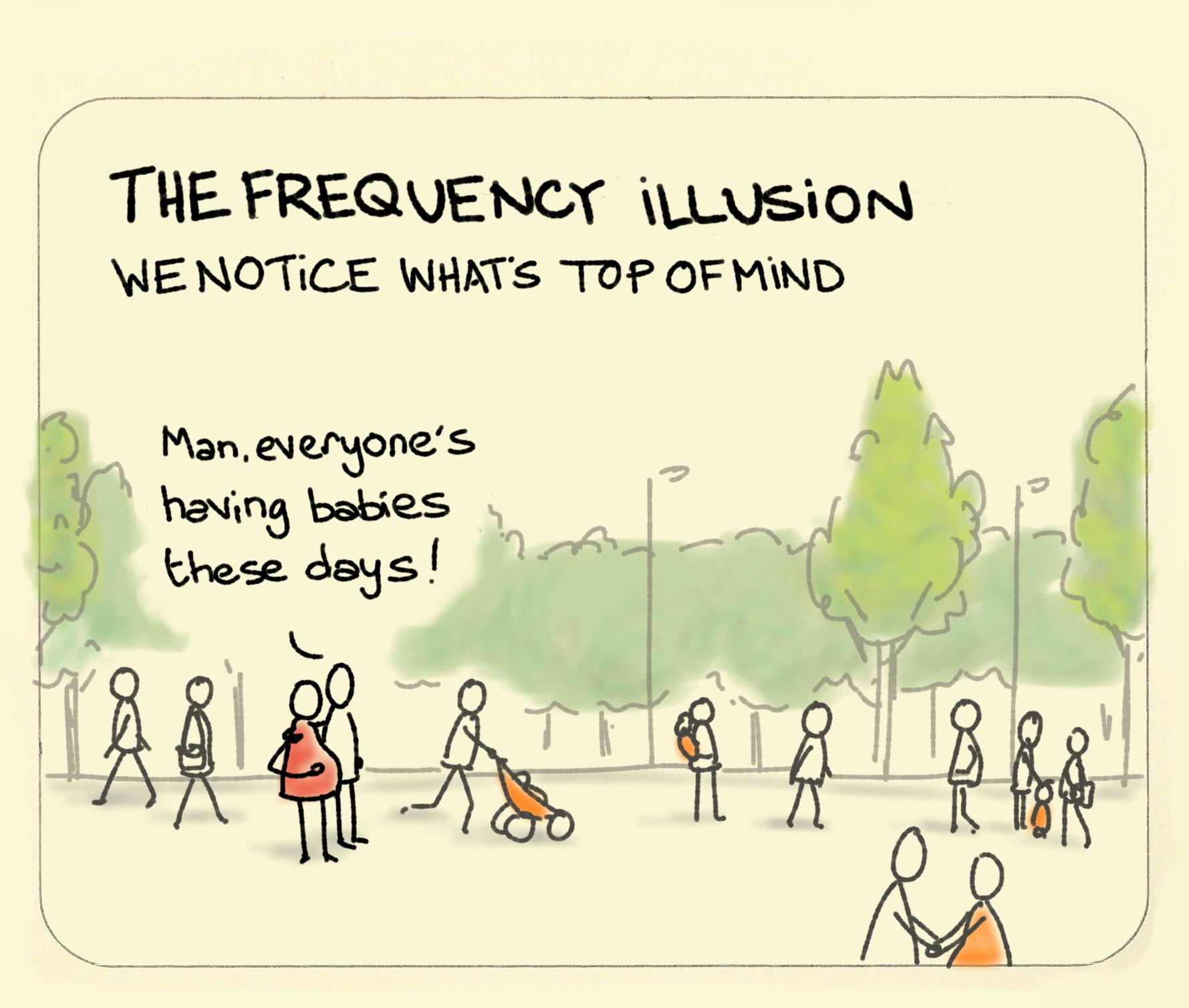
This cognitive bias, also known as the frequency illusion, occurs when something you’ve just noticed or learned suddenly seems to appear everywhere. The effect stems from two interacting mental processes: selective attention and confirmation bias.
The Baader-Meinhof Phenomenon, also known as the frequency illusion. Image: Public Domain.
Selective attention acts as the brain’s filter. Every moment, your sensory system processes millions of stimuli — sounds, sights, textures, smells. Conscious awareness can handle only a tiny fraction. The reticular activating system, a network of neurons in the brainstem, determines what deserves attention based on your current goals, interests, and recent experiences. When you learn something new, the system flags it as important and begins scanning the environment for matches, bringing previously ignored instances into conscious awareness. This process resembles how a computer allocates more processing resources to active applications.
Confirmation bias then reinforces the pattern. Once you notice the new word or car model a few times, you form a belief that it’s appearing more frequently. Your brain then seeks evidence supporting this belief while ignoring contradictory information. You remember every instance of the silver Civic but fail to notice the dozens of other cars passing between them. The result is a compelling illusion of increased frequency that has nothing to do with actual statistical changes.
The phenomenon’s memorable name originated from a 1994 letter to the St. Paul Pioneer Press. Commenter Terry Mullen had mentioned the Baader-Meinhof Group — a West German terrorist organization from the 1970s — and then encountered another reference to the group within 24 hours. Amused by the coincidence, he coined the term “Baader-Meinhof phenomenon” in his letter. The name stuck, though Stanford linguistics professor Arnold Zwicky later proposed “frequency illusion” as a more descriptive alternative in 2005.
The effect differs from the related “recency illusion,” which Zwicky also identified. The recency illusion leads people to believe that something they recently noticed is itself new to the world — that the word they just learned must be a recent addition to the language. The frequency illusion concerns only the perceived increase in occurrence, not the perceived novelty of the thing itself.
While generally harmless, the Baader-Meinhof phenomenon can distort decision-making in professional contexts. A physician who learns about a rare diagnosis may suddenly see it everywhere, leading to overdiagnosis. A detective focused on a particular suspect may notice only evidence pointing toward that suspect while missing exculpatory clues. A board member who mentions a business strategy may then perceive it in every industry report, potentially compromising confidential information or creating false consensus.
The phenomenon can also reinforce mental health symptoms. For individuals with schizophrenia or paranoid disorders, the frequency illusion can validate delusional beliefs — a patient who believes they’re being followed may suddenly “notice” evidence of surveillance everywhere, confirming their paranoia.
But the effect can also be harnessed productively. Language learners can use it to reinforce vocabulary by intentionally exposing themselves to new words in multiple contexts. Students learning dialectical behavior therapy skills report seeing more opportunities to practice mindfulness or distress tolerance after initial training. Deliberately triggering the frequency illusion through frequent review and environmental reminders can accelerate skill acquisition.
The Baader-Meinhof phenomenon ultimately reveals how much of “reality” is constructed by the brain’s attentional filters. That silver Honda Civic was always on the road — you simply didn’t have a reason to notice it before. The word “defenestration” appeared in books throughout your life, but your visual cortex treated it as background noise until your hippocampus flagged it as relevant. We don’t passively observe the world; we actively construct it through the lens of what we deem important.
The next time you feel like the universe is sending you a message through repeated coincidences, remember: it’s not the world that changed. It’s your brain, suddenly tuned to a frequency that was always broadcasting. You’re not seeing more of something. You’re just finally paying attention.
In March 1964, 28-year-old Kitty Genovese was murdered outside her apartment building in Queens, New York. According to initial reports, 38 neighbors witnessed the attack...