


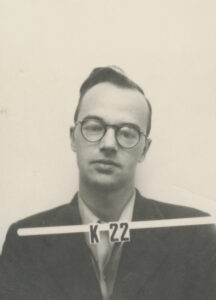
In the summer of 1945, as American scientists anxiously awaited the detonation of the world’s first atomic device at a remote New Mexico test site code-named Trinity, one of the men who helped design the bomb was quietly composing notes for the enemy. Klaus Fuchs was a theoretical physicist, a trusted colleague, and a British citizen. He was also a Soviet spy. The secrets he passed to Moscow did not merely embarrass the Western allies; according to the U.S. Congressional Committee on Atomic Espionage, his espionage “influenced the safety of more people and accomplished greater damage than any other spy not only in the history of the United States, but in the history of nations.”¹ It is a verdict that has only hardened with time.
Origins of a True Believer
Emil Klaus Julius Fuchs was born on December 29, 1911, in Rüsselsheim, Germany, the son of a Lutheran pastor who later became a Quaker and a committed social activist.² The family’s moral seriousness proved contagious. By the time Fuchs enrolled at the University of Leipzig in 1930, the Weimar Republic was convulsing under economic collapse and political extremism. He joined the Social Democratic Party, then transferred his loyalties to the German Communist Party (KPD), not out of casual youthful rebellion but because the Communists were mounting the most vigorous physical resistance to the rising Nazi movement on campus.³ After Brown-shirted thugs beat him badly enough that he was left for dead in a river, Fuchs’s ideological commitment was not broken. It was cemented.
When Hitler became chancellor in January 1933, Fuchs fled to England, eventually finding his way into the orbit of two towering figures in theoretical physics: Nevill Mott at the University of Bristol, and later Max Born at the University of Edinburgh, where he earned a doctorate. Born, who would go on to win the Nobel Prize in Physics, regarded Fuchs as a man of exceptional brilliance. It was a reputation that would open every door that mattered, including the doors to the most classified project in the history of warfare.⁴
Into the Heart of the Secret
In 1941, Fuchs was recruited to work on Britain’s atomic bomb program, code-named Tube Alloys, as an assistant to the German-born physicist Rudolf Peierls at the University of Birmingham. That same year, moved by a belief that the Soviet Union had a moral right to know about a weapon that could reshape the entire postwar order, he volunteered his services to Soviet military intelligence through a German Communist contact, Jürgen Kuczynski.⁵ He was assigned a handler: the legendary “Sonya,” also known as Ursula Beurton, a German Communist and GRU major who had previously worked with the Sorge spy ring in Asia.⁶
In late 1943, Fuchs crossed the Atlantic as part of a British scientific delegation to work on the Manhattan Project, first at Columbia University in New York on uranium enrichment, and then at Los Alamos, New Mexico, where he arrived in August 1944 to work under Hans Bethe in the Theoretical Division. There he became one of the foremost experts on implosion physics, the mechanism at the heart of the plutonium bomb. His American handler, Harry Gold (code-named “Raymond”), met him in Santa Fe to collect the intelligence Fuchs had memorized with photographic precision: diagrams, yield calculations, design specifications.⁷ As physicist Frank Close, who worked under Peierls himself as a graduate student and later wrote the most comprehensive account of the case, concluded: “It was primarily Fuchs who enabled the Soviets to catch up with Americans” in the nuclear arms race.⁸
The information Fuchs delivered was staggering in both scope and precision. Well ahead of the Trinity test on July 16, 1945, Moscow had received detailed specifications of the implosion bomb. Soviet scientists, overseen by Igor Kurchatov and supervised by the terrifying Lavrentii Beria, were not starting from scratch. They were working from a blueprint.⁹ Stanford historian David Holloway, whose authoritative Stalin and the Bomb remains the definitive study of the Soviet nuclear program, documents how Fuchs’s intelligence helped Kurchatov’s team accelerate what would otherwise have been a far slower process of independent discovery.¹⁰ When the Soviets detonated “Joe-1,” a near-exact replica of the American Fat Man plutonium bomb, at the Semipalatinsk test site in Kazakhstan on August 29, 1949, Western intelligence agencies were stunned. The bomb bore the unmistakable signature of what Fuchs had provided. His espionage had compressed the Soviet timeline by anywhere from one to several years.¹¹
The Double Mind
What drove Fuchs to betray colleagues who trusted him implicitly, including Peierls, who had championed him professionally and welcomed him into his home? Fuchs himself spoke of what he called a “controlled schizophrenia”: the ability to compartmentalize his espionage identity from his life as a respected scientist.¹² Historian Nancy Thorndike Greenspan, whose 2020 biography Atomic Spy draws on archives long hidden in Germany, argues that Fuchs was motivated less by personal gain (he received nothing from the Soviets) than by an ideological conviction that a single nation’s monopoly on atomic weapons posed a catastrophic danger to global stability.¹³ He later expressed genuine surprise at the speed of Soviet success, stating that he had been convinced “the information he had given could not have been applied so quickly,” suggesting he may have underestimated, even in his own mind, the magnitude of what he had handed over.¹⁴
Dick White, who would later become Director General of MI5, offered a measured verdict: Fuchs’s motives were “relatively speaking pure. A scientist who got cross at the Anglo-American ploy in withholding vital information from an ally fighting a common enemy.”¹⁵ Others were less charitable. Hans Bethe, the Nobel laureate who headed the Theoretical Division at Los Alamos and worked alongside Fuchs every day, once remarked that Fuchs was “the only physicist he knew to have truly changed history,” words that carry the full weight of their tragic ambiguity.¹⁶
Unmasking and Aftermath
Fuchs returned to Britain in 1946 and was appointed head of the Theoretical Physics Division at the Atomic Weapons Research Establishment at Harwell, continuing to pass secrets on Britain’s own nuclear program until February 1949. His unraveling came not through traditional surveillance but through cryptanalysis. The American Venona project, which decrypted wartime Soviet intelligence cables, identified a source code-named REST as someone matching Fuchs’s profile. Because the Venona intercepts were too classified to use as court evidence, MI5 dispatched a former Special Branch officer, William “Jim” Skardon, to extract a confession through patient psychological pressure.¹⁷ After several interviews, Fuchs confessed in January 1950. He was convicted on March 1, 1950, under Britain’s Official Secrets Act (not treason, since the Soviet Union had been an ally during the relevant period) and sentenced to fourteen years in prison.¹⁸
He served nine years, was released in 1959, and emigrated to East Germany, where he was appointed deputy director of the Central Institute for Nuclear Research at Rossendorf and received the country’s highest honors. He remained an unrepentant Communist until his death on January 28, 1988, never visiting England again, never speaking to Peierls again. His greatest regret, he reportedly said, was not the espionage but the loss of his British citizenship.¹⁹
The legacy of Klaus Fuchs resists simple moral accounting. He was a refugee who repaid British hospitality with betrayal. He was an anti-fascist hero who served a regime committing its own atrocities. He was a scientist of rare genius who weaponized that genius for a foreign power. And he was, in the cold arithmetic of nuclear deterrence, an inadvertent architect of the balance of terror that kept the Cold War from going hot. Whether that makes him a villain, a visionary, or simply a man destroyed by the collision of two absolute loyalties remains a question without a comfortable answer.
Endnotes
¹ Frank Close, Trinity: The Treachery and Pursuit of the Most Dangerous Spy in History (London: Allen Lane, 2019). The Congressional finding originates from the U.S. Joint Committee on Atomic Energy, 1951, as quoted in Close. See also the publisher’s description at Penguin Books.
² Klaus Fuchs biographical profile, MI5 — The Security Service, https://www.mi5.gov.uk/history/the-cold-war/klaus-fuchs.
³ Nancy Thorndike Greenspan, Atomic Spy: The Dark Lives of Klaus Fuchs (New York: Viking, 2020). Greenspan’s account of Fuchs’s radicalization at Leipzig draws on German archival material previously unavailable to researchers. Publisher’s page: Penguin Random House.
⁴ Klaus Fuchs biographical page, University of Edinburgh Alumni Services, https://alumni.ed.ac.uk/services/notable-alumni/alumni-in-history/klaus-fuchs. Max Born’s role as Fuchs’s mentor is discussed at length in Greenspan, Atomic Spy, and also in Greenspan’s earlier biography of Born: The End of the Certain World (New York: Basic Books, 2005).
⁵ MI5, “Klaus Fuchs.” Fuchs’s stated motivation appears in his confession, summarized in both MI5 records and in Close, Trinity.
⁶ Ben Macintyre, Agent Sonya: Lover, Mother, Soldier, Spy (New York: Viking, 2020), covers Beurton’s career in full; her relationship with Fuchs is addressed in Chapters 17–19. See also B. de Jong, “Book Review: Frank Close, Trinity,” Security and Defence Quarterly 45, no. 1 (2024): 97–100, https://securityanddefence.pl/Book-Review-Frank-Close-2019-Trinity-The-treachery-and-pursuit-of-the-most-dangerous,183020,0,2.html.
⁷ Klaus Fuchs profile, Atomic Heritage Foundation / National Museum of Nuclear Science and History, https://ahf.nuclearmuseum.org/ahf/profile/klaus-fuchs/. Gold’s code name and role are confirmed in MI5’s published account.
⁸ Close, Trinity, as summarized in the Survival (IISS) review: Rodric Braithwaite, “The Overdetermined Cold War,” Survival 61, no. 6 (2019), https://www.tandfonline.com/doi/abs/10.1080/00396338.2019.1688579.
⁹ B. de Jong, “Book Review,” Security and Defence Quarterly, 98. The encrypted message transmitting Trinity specifications to Moscow on June 13, 1945 is documented using the Vassiliev Notebooks from the Wilson Center Digital Archive.
¹⁰ David Holloway, Stalin and the Bomb: The Soviet Union and Atomic Energy, 1939–1956 (New Haven: Yale University Press, 1994). Winner of the Vucinich Prize from the American Association for the Advancement of Slavic Studies. Yale University Press page: https://yalebooks.yale.edu/book/9780300066647/stalin-and-the-bomb/. For Holloway’s elaboration on Fuchs’s role, see his Atomic Heritage Foundation oral history: https://ahf.nuclearmuseum.org/voices/oral-histories/david-holloways-interview/.
¹¹ Atomic Heritage Foundation, Klaus Fuchs profile. Estimates of time saved range from several months to several years; the academic consensus, informed by post-Soviet archive openings, suggests acceleration of roughly one to two years for the fission bomb.
¹² Close, Trinity. The “controlled schizophrenia” phrase appears in Fuchs’s own statement during interrogation and is analyzed at length by both Close and Greenspan.
¹³ Greenspan, Atomic Spy. See also the Library Journal review by Philip Shackelford (May 1, 2020): https://www.libraryjournal.com/review/atomic-spy-the-dark-lives-of-klaus-fuchs.
¹⁴ MI5, “Klaus Fuchs.” Fuchs made this statement to Michael Perrin of the Atomic Energy Authority during his confession.
¹⁵ MI5, “Klaus Fuchs.” Dick White’s assessment is quoted from declassified MI5 files.
¹⁶ Bethe’s remark is cited in the MI5 account and widely referenced in the secondary literature, including Close, Trinity.
¹⁷ Close, Trinity; MI5, “Klaus Fuchs.” Close’s research confirmed that GCHQ decrypters supplied the definitive proof of Fuchs’s guilt, correcting the long-held assumption that American signals intelligence deserved primary credit.
¹⁸ Atomic Archive biographical summary, https://www.atomicarchive.com/resources/biographies/fuchs.html. Fuchs could not be charged with treason because the USSR was a British ally during the period of his espionage, which limited his sentence to the maximum under the Official Secrets Act.
¹⁹ University of Edinburgh Alumni Services, “Klaus Fuchs.” His release, emigration, and post-prison career are also detailed in Greenspan, Atomic Spy, Chapters 20–21. The remark about citizenship appears in Norman Moss, Klaus Fuchs: The Man Who Stole the Atom Bomb (New York: St. Martin’s Press, 1987), an earlier biographical treatment based on interviews with those who knew him.