

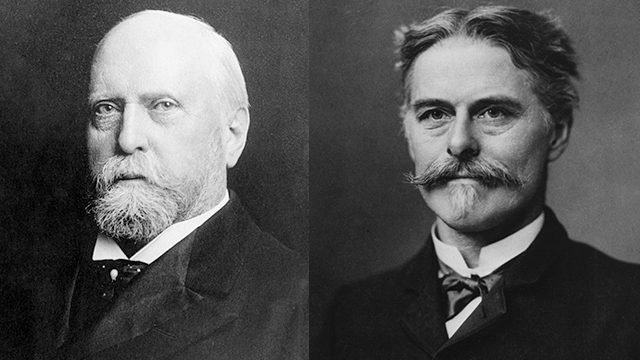
In the summer of 1868, a young paleontologist named Othniel Charles Marsh visited a colleague’s fossil beds in Haddonfield, New Jersey, and did something that would poison American science for the next thirty years. He bribed the miners.
The marl pits belonged, in effect, to Edward Drinker Cope — not legally, but by the codes of scientific courtesy that governed how gentlemen naturalists shared access to promising dig sites. Cope had invited Marsh there as a collegial gesture. When Marsh saw the quality of the fossils coming out of the ground, he quietly paid the workers to redirect future shipments to his collection in New Haven, Connecticut, rather than Cope’s study in Philadelphia. When Cope found out, the reaction was volcanic. The two men would spend the next three decades trying to professionally destroy each other — and in doing so, they would accidentally discover more than 140 new species of dinosaurs and drag American paleontology from obscurity to the front pages of every major newspaper in the country.¹
Two Men Who Should Have Known Better
The irony of the Bone Wars is that neither Cope nor Marsh needed to cheat. Both were already brilliant. Both were already well-funded. And both, at the time of Marsh’s betrayal, were young enough to have built extraordinary careers without the scorched-earth campaign that consumed them both.
Othniel Charles Marsh was born in 1831 in Lockport, New York, the son of a struggling farm family. His life changed when his uncle — the fabulously wealthy philanthropist George Peabody — decided to finance his nephew’s education. Marsh attended Phillips Academy, graduated from Yale, and spent years studying in Germany, returning to become the first professor of paleontology at an American university. Peabody, at Marsh’s persistent urging, also funded the construction of the Peabody Museum of Natural History at Yale, which Marsh would run as his personal fiefdom.²
Edward Drinker Cope was born in 1840 in Philadelphia to wealthy Quaker parents who wanted him to become a farmer. He had other ideas. A child prodigy with an almost frightening facility for scientific classification, he published his first scholarly article at eighteen while working as a researcher at the Academy of Natural Sciences. He studied comparative anatomy under Joseph Leidy — then America’s most respected vertebrate paleontologist — and was, by his mid-twenties, producing work of genuine distinction. When Cope met Marsh in Berlin in 1863, both men were on European tours of scientific institutions, and by all accounts they got on well. Five years later, the New Jersey marl pits changed everything.³
The War Begins
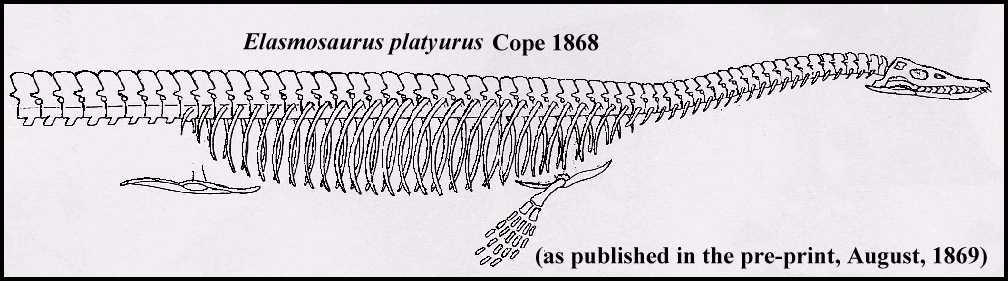
The first major public exchange of hostilities came from what should have been a routine scientific correction. In 1868, Cope published a detailed description of Elasmosaurus platyurus, a long-necked marine reptile from the Cretaceous period. The paper was meticulous, confident, and wrong in one spectacular way: Cope had attached the skull to the wrong end of the skeleton, placing the head on the tail. Marsh noticed, told Cope quietly, and then — when Cope proved slow to acknowledge the error — made sure everyone in the American scientific community knew about it.
The humiliation was total. Cope tried to buy up every copy of the paper. He largely failed.⁴ What he succeeded in doing was ensuring that, from that moment forward, every scientific exchange between the two men would be conducted as an act of war.
The terrain for the war’s main engagements was the American West. In the late 1870s, workers laying track for the transcontinental railroads were routinely blasting through ancient rock formations and turning up enormous bones. In 1877, two separate letters arrived on the same day at Yale’s Peabody Museum — one from a teacher named Arthur Lakes in Morrison, Colorado, and one from a high school principal named O. W. Lucas in Canyon City — describing fossil beds of staggering richness. Marsh dispatched collectors to both sites immediately, swearing them to secrecy. When Cope got wind of it, he dispatched his own teams. The race was on.
The Morrison Formation and What It Contained
The Morrison Formation — a vast geological deposit of Late Jurassic rock running from New Mexico to Montana — turned out to be the richest dinosaur graveyard ever found on Earth. Between 1877 and the early 1890s, the competing teams of Cope and Marsh extracted from its beds an inventory of prehistoric life that reads like a catalog of every dinosaur poster ever hung in a child’s bedroom. From Marsh’s operations came Stegosaurus, Triceratops, Diplodocus, Allosaurus, and Brontosaurus (the last of which was almost certainly a misidentified Apatosaurus, as Marsh had confused the two based on skull errors — a fact that would take decades to sort out). From Cope’s came Camarasaurus, Coelophysis, and dozens of other genera.⁵
The pace of discovery was extraordinary, and it came at a price. Both men were so frantic to publish first — to stake the naming rights to a new species before the other could — that they telegraphed preliminary descriptions directly from field camps to journals, sometimes based on nothing more than a few fragments of bone. The errors that resulted would occupy paleontologists for the next half century. Marsh’s famous Brontosaurus mistake, in which he combined Apatosaurus bones with the skull of a different genus entirely, was only definitively corrected in 1970, nearly a century after the original excavations.⁶ Science writer Riley Black, who has written extensively on the Morrison Formation’s legacy, describes the period’s publications as producing “a tangle of confusion” that the field is in some respects still unraveling.⁷
The Tactics of Mutual Destruction
The violence of the Bone Wars was not only scientific. Marsh hired spies to shadow Cope’s field teams, referring to his rival in internal correspondence by the codename “Jones.” He used his position as the chief paleontologist of the U.S. Geological Survey — secured through political connections that Cope, despite his abilities, could not match — to throttle Cope’s access to government funding. When Cope applied for Survey positions, Marsh worked behind the scenes to block him. When Cope’s field teams found rich sites, Marsh’s men were sometimes dispatched to the same area with instructions to exhaust whatever fossils remained — and then, critically, to smash any bones they couldn’t carry before departing, so that nothing would fall into Cope’s hands.⁸
Cope responded in kind. He purchased the scientific journal The American Naturalist in 1877, giving himself an in-house publication platform that he used to fire off species descriptions at a pace that bordered on mania. Between 1879 and 1880 alone, he published 76 academic papers. Over his lifetime, he authored approximately 1,400 scientific publications — a rate of production that remains almost incomprehensible and that required a systematic lowering of standards that would have embarrassed a calmer, less desperate man.⁹
Meanwhile, Cope was quietly assembling a dossier. For years, he maintained in the bottom drawer of his desk a running journal documenting every mistake, every malfeasance, every act of scientific fraud he believed Marsh had committed. The entries accumulated. In January 1890, he handed them to a reporter.
“Scientists Wage Bitter Warfare”
The New York Herald published the story on January 12, 1890, under the headline “Scientists Wage Bitter Warfare.” It covered multiple pages and included detailed accusations from Cope against Marsh: that Marsh had plagiarized the work of field collectors, stolen credit from subordinates, and produced shoddy science. Marsh responded in the same newspaper with his own catalog of Cope’s errors, including the Elasmosaurus skull debacle. The two men conducted a multi-day public brawl in the pages of a major newspaper, airing thirty years of mutual grievance before an enthralled general public.
As Elizabeth Noble Shor documents in her scholarly account of the rivalry, the effect on the broader scientific community was one of mortified horror: “Most scientists of the day recoiled to find that Cope’s feud with Marsh had become front-page news. Those closest to the scientific fields under discussion, geology and vertebrate paleontology, certainly winced, particularly as they found themselves quoted, mentioned, or misspelled.”¹⁰ The Herald affair damaged both men — but it also ended the Survey’s willingness to continue backing Marsh, who lost his government funding shortly afterward.
The Reckoning
By the mid-1890s, both men were broken. Cope had spent his entire personal fortune — an inheritance of considerable size — on expeditions, publications, and the purchase of The American Naturalist. He had sold his house. He had sold most of his fossil collection. He was living in a single room of what had been his Philadelphia home, surrounded by the specimens he couldn’t bear to part with and the reptiles he kept as pets.¹¹ Marsh, despite his Yale professorship and the Peabody Museum, was similarly depleted — the costs of maintaining multiple field teams and fighting a decades-long political and scientific campaign had consumed the Peabody inheritance.
Cope died in April 1897, at fifty-six, in that single Philadelphia room. He had arranged to have his brain preserved and his skull donated to science, reportedly hoping that his brain would prove larger than Marsh’s. Marsh, informed of this gambit, declined to participate. He died two years later, in March 1899, at sixty-seven.¹²
They left behind, between them, over 140 newly described dinosaur species, tens of thousands of fossil specimens that formed the backbone of the Smithsonian Institution and the Peabody Museum’s collections, and a body of work that effectively established vertebrate paleontology as a serious American science. Before Cope and Marsh began their war, there were fewer than nine named dinosaur species in North America. By the time it ended, the field was unrecognizable. Charles Darwin himself, reviewing Marsh’s fossil evidence for the evolution of ancient horses — a sequential record so complete it was unprecedented — wrote a personal letter declaring it “the best support for the theory of evolution in twenty years.”¹³
What the War Cost and What It Built
The Bone Wars are remembered now primarily as a cautionary tale about ego, competition, and the distortion of science by personal animus. Both assessments are correct. The errors introduced into the paleontological literature by the men’s racing, slipshod publication habits took decades to untangle, and the bitterness their feud generated poisoned American scientific institutions for a generation. As Mark Jaffe, whose book The Gilded Dinosaur remains the most thorough account of the period, demonstrates at length, the war between Cope and Marsh was not merely a personal matter — it was deeply entangled with the opening of the American West, the corruption of Gilded Age politics, and the fundamental question of whether the United States government would fund science at all.¹⁴
And yet the bones are real. Stegosaurus is real. Triceratops is real. Diplodocus fills the great hall of the Carnegie Museum of Natural History in Pittsburgh, where it has stood since 1899, the largest mounted dinosaur in the world when it was installed, and it is there because two men who despised each other drove their field workers through blizzards and hostile territory to dig it out of the Wyoming badlands before the other side could find it first.
The museum visitor who stands beneath that skeleton and cranes her neck upward is the beneficiary, at several removes, of the worst professional behavior in the history of American science. The dinosaur doesn’t care. It just hangs there in its ribs and vertebrae, enormous and indifferent, as it has since the Jurassic — long before there was anyone to fight over it.
Endnotes
¹ The Gilded Dinosaur: The Fossil War Between E.D. Cope and O.C. Marsh and the Rise of American Science (New York: Crown Publishers, 2000), 31–35; PBS American Experience, “O.C. Marsh and E.D. Cope: A Rivalry,” https://www.pbs.org/wgbh/americanexperience/features/dinosaur-rivalry/.
² The Gilded Dinosaur, 14–22; Elizabeth Noble Shor, The Fossil Feud Between E.D. Cope and O.C. Marsh (Hicksville, NY: Exposition Press, 1974), 3–12; Science 186, no. 4166 (November 29, 1974): 819–820, https://doi.org/10.1126/science.186.4166.819.b
³ Shor, The Fossil Feud, 12–20; Jaffe, The Gilded Dinosaur, 22–30; PBS American Experience, “O.C. Marsh and E.D. Cope: A Rivalry.”
⁴ The Gilded Dinosaur, 37–44; Riley Black (writing as Brian Switek), “The Bone Wars,” Smithsonian Magazine, January 14, 2010, https://www.smithsonianmag.com/science-nature/the-bone-wars-59523149/
⁵ Jaffe, The Gilded Dinosaur, 143–68; PBS American Experience. John Foster, Jurassic West: The Dinosaurs of the Morrison Formation and Their World (Bloomington: Indiana University Press, 2007), 1–9.
⁶ Jaffe, The Gilded Dinosaur, 155–60. John S. McIntosh and David S. Berman, “Description of the Palate and Lower Jaw of the Sauropod Dinosaur Diplodocus (Reptilia: Saurischia) with Remarks on the Nature of the Skull of Apatosaurus,” Journal of Paleontology 49, no. 1 (January 1975): 187–99, https://www.jstor.org/stable/1303324
⁷ Riley Black, “The Bone Wars,” Smithsonian Magazine, January 14, 2010 and My Beloved Brontosaurus: On the Road with Old Bones, New Science, and Our Favorite Dinosaurs (New York: Scientific American/Farrar, Straus and Giroux, 2013).
⁸ Jaffe, The Gilded Dinosaur, 195–215; Shor, The Fossil Feud, 112–40.
⁹ PBS American Experience, “O.C. Marsh and E.D. Cope: A Rivalry.”
¹⁰ Shor, The Fossil Feud, 201. The New York Herald headline — “Scientists Wage Bitter Warfare” — appeared on January 12, 1890, and the multi-day exchange between Cope, Marsh, and John Wesley Powell is documented in full in Jaffe, The Gilded Dinosaur, 302–24. Shor’s quotation on the scientific community’s response is widely cited; its context in her book is pages 199–203.
¹¹ Jaffe, The Gilded Dinosaur, 340–60; Riley Black, The Secret Life of Bones: Their Origins, Evolution and Magic (London: Bloomsbury Sigma, 2019), 196–200.
¹² Jaffe, The Gilded Dinosaur, 361–70; National Geographic, “Rock Star Scholars: The Bone Wars,” May 21, 2024, https://www.nationalgeographic.com/history/article/bone-wars-paleontology-feud
¹³ PBS American Experience, “O.C. Marsh and E.D. Cope: A Rivalry,” https://www.pbs.org/wgbh/americanexperience/features/dinosaur-rivalry/
¹⁴ Jaffe, The Gilded Dinosaur, 1–11 (introduction), and 400–14 (conclusion). Publishers Weekly review of Jaffe’s book, which describes the book as situating the rivalry within “the explosion of industrial capitalism and the new expression of America’s status as a world power,” https://www.publishersweekly.com/978-0-517-70760-9