

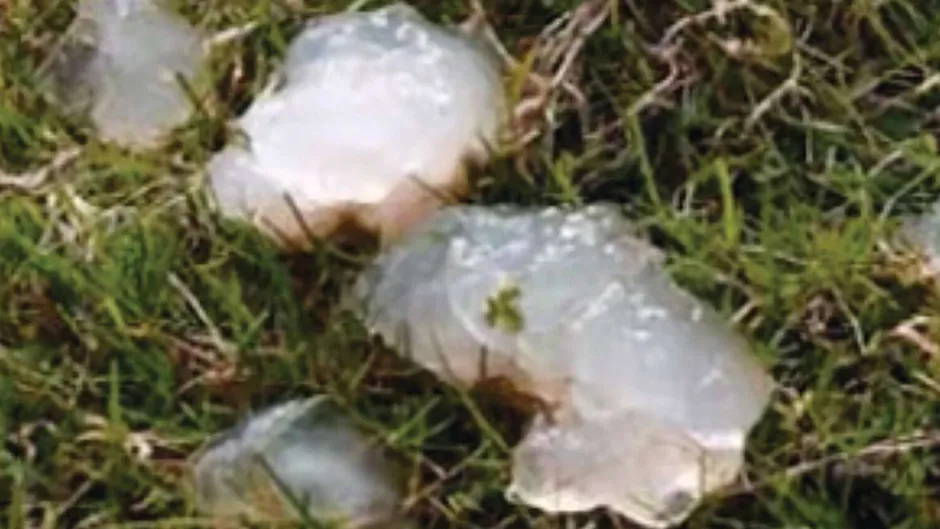
On the morning of August 7, 1994, a woman named Dotty Hearn stepped outside her farmhouse in Oakville, Washington, and found something she could not explain. She had heard what she thought was a heavy storm in the night, and now she was standing in its aftermath. The yard, the outbuildings, the wood box on the porch — all of it was covered in translucent, gelatinous pellets, each roughly half the size of a grain of rice. They looked, she later said, like hailstones. When she touched one with her bare hand, it felt nothing like ice. It was soft, slightly sticky, and vaguely organic — like something that had once been alive.
Hearn thought little of it, went back inside, and got on with her morning. By that afternoon, she was on the floor of her bathroom, barely conscious, suffering from severe vertigo and nausea. Her daughter, Sunny Barclift, called an ambulance. Dotty Hearn spent the next four days in the hospital. Her doctor, a local physician named David Little, listed her diagnosis as “some type of virus” and sent her home. He had no better answer to offer, and nothing in his training had prepared him for the question she was actually asking: what happens to a person who touches gelatinous rain?
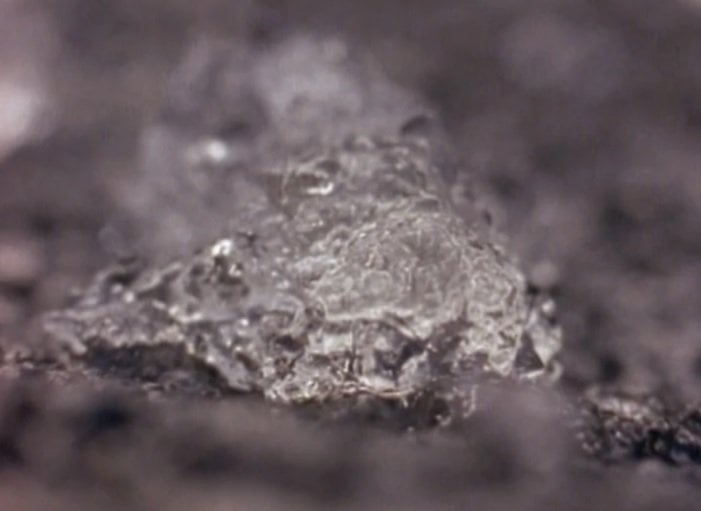
It was a question that would occupy the residents of Oakville, a timber town of roughly 665 people in Washington State’s Grays Harbor County, for years — and that the scientific establishment would never fully answer.
The Officer and the Smear
Dotty Hearn was not the first person to encounter the blobs. In the early hours of that same August morning, a police officer named David Lacey was on patrol in his cruiser when rain began to fall. In Oakville, which receives approximately 52 inches of precipitation a year — well above the national average — rain is not an event. It is a condition. Lacey turned on his windshield wipers automatically and then noticed something was wrong. The wipers were not clearing the glass. They were smearing it, as though someone had rubbed petroleum jelly across the windshield in the dark.
Lacey pulled into a gas station, put on latex gloves, and touched the substance. It was, he later told the local paper, “very mushy, almost like if you had Jell-O in your hand.”¹ He had no idea what he was touching. Nobody did. Over the following three weeks, the substance fell at least five more times over an area of roughly twenty square miles surrounding Oakville. Six separate blob events in three weeks, concentrated on the same small community, always arriving with or just before rain.
After the first event, Barclift — who worked in occupational health and safety and had collected her own samples while wearing gloves — sent a specimen to the Washington State Department of Ecology’s Hazardous Materials Unit. A second sample went to a local hospital. The two institutions, analyzing what appeared to be the same substance, arrived at sharply contradictory conclusions.
What the Tests Found — and Didn’t
The hospital’s initial finding was alarming: a lab technician reported that the blobs appeared to contain human white blood cells. The implication was unsettling enough that it circulated rapidly through Oakville: if the substance falling from the sky contained human cellular material, what, exactly, was it made of, and where had it come from?
The Department of Ecology’s answer, delivered by agency scientist Mike Osweiler, cut against the hospital’s finding in a specific and important way. Osweiler told Tom Paulson of the Seattle Post-Intelligencer that his analysis had found “a number of cells of various sizes” — confirming that the material was biological in origin, from a once-living creature — but that the cells he observed had no nuclei.² This mattered enormously, because human white blood cells have nuclei. Whatever the hospital had seen, Osweiler’s analysis suggested it was not human in origin. The cells were prokaryotic — the kind found in bacteria and archaea, not in human tissue.
The New York Times, which picked up the story on August 20, 1994, under the headline “Mystery Blobs Were Once Alive,” reported Osweiler’s findings as the most credible scientific account available, while noting that the overall picture remained deeply unclear.³ Two types of bacteria had been found in the blobs, but neither had been successfully identified. The substance was biological. It had fallen from the sky at least six times over three weeks. That was, in August 1994, the sum total of what science could say with confidence.
Osweiler himself told Paulson, regarding the leading theory that the Air Force’s bombing practice runs over the Pacific Ocean forty to fifty miles away had somehow pulverized jellyfish and scattered their remains over Oakville: “That’s a long way for jellyfish to travel. This is a head-scratcher.”⁴
Theories, Each With a Fatal Flaw
Every theory that emerged carried a problem that its proponents preferred not to dwell on.
Jellyfish, dispersed by military bombing: The Air Force confirmed it had been conducting practice runs over the Pacific in the weeks preceding the blob events. But Oakville sits forty miles inland. No neighboring communities reported blob events. The blobs, by every account, were uniform in size — rice-grain pellets — with no tentacles, no coloration, and none of the structural features of jellyfish tissue. And the bombing, if that’s what it was, would need to have dispersed biological material inland on at least six separate occasions over three weeks. The atmospheric mechanics required make this essentially impossible.
Aircraft waste: The presence of what the hospital had identified (perhaps wrongly) as human cellular material prompted the theory that the blobs were frozen waste from a commercial or military aircraft toilet. The FAA addressed this directly: aircraft waste systems use a distinctive blue chemical dye, and the blobs were transparently clear. The FAA found no supporting evidence.⁵ This theory also does nothing to explain six separate events.
Military biological testing: The theory that gained the most traction among Oakville residents — and that the 1997 Unsolved Mysteries episode amplified considerably — was that the U.S. military had been conducting covert biological weapons tests over the community. The military denied any such program. No documents have ever surfaced to support the claim. As Paulson told KUOW’s Soundside program in May 2025, reflecting on thirty years of living with his most-reprinted story, the Unsolved Mysteries treatment had significantly escalated the conspiracy elements beyond what the original reporting warranted. “The blobs of Oakville are probably the most long-lived, most re-reported story of mine,” he said, with what sounded like complicated feelings. “So that’s my legacy.”⁶
The Evidence Disappears
Whatever the Oakville blobs were, there is now no way to find out. This is perhaps the most genuinely disturbing aspect of the story: the physical evidence is gone, and its disappearance was not the result of a government seizure or a cover-up. It was the result of institutional indifference.
The samples collected by Barclift and submitted to the Department of Ecology and the Department of Health were used in the initial analyses and then, apparently, discarded or lost. The Washington State Department of Health has reportedly stated that it has no record of ever receiving samples — a claim that contradicts Barclift’s account of submitting them, and that remains unresolved. The blobs that were not collected dissolved naturally: the substance, whatever it was, was not stable at ambient temperature. It simply melted away, leaving behind no trace that could be tested by later, more sophisticated methods.
Microbiologist Mike McDowell, who analyzed samples for the Washington State Department of Health and later appeared on Unsolved Mysteries, said he had identified one of the two bacterial strains as one known to have adverse effects on the human digestive system. He was not, even by 1997, able to say how the bacteria had ended up concentrated in gelatinous pellets falling from the sky over a small Washington town, or whether those bacteria were responsible for the illnesses that followed.⁷ The question of whether the blob events and the wave of illness in Oakville were causally connected — or merely coincidental — was never definitively answered, because the scientific investigation was never definitively completed.
The Town, the Legend, and the Return
Oakville is a town named, according to local history, after Washington State’s only native oak tree. Before the summer of 1994, it was known mainly for logging, for a building rumored to be the last bank robbed on horseback in American history, and for its annual rodeo. After 1994, it became known for the blobs. The story has proven extraordinarily durable — resurfacing every few years in the press, on documentary television, and on the internet — partly because it is genuinely strange and partly because it was never resolved.
In April 2025, a woman named Alli McCrite returned home from work to her house in Rochester, Washington — about eight miles from Oakville — and found gelatinous blobs falling from the sky. They were clear, odorless, palm-sized, and unlike anything she had seen before. “I used to live in Oakville, so obviously I knew about the Oakville blobs,” she told KUOW. “I was like, ‘Oh my gosh: This is literally what happened.’”⁸ She collected samples in a jar. The blobs later melted at room temperature. The 2025 Rochester blobs were subsequently identified, at least tentatively, as polyacrylamide — a synthetic polymer used in agriculture and water treatment that can form clear gels and has, on rare occasions, been reported falling from the sky in association with unusual weather systems. No such identification was ever made for the 1994 Oakville events.
Whether the 2025 Rochester blobs and the 1994 Oakville blobs were the same phenomenon is unknown. Whether polyacrylamide — a substance not known to cause flu-like illness — could account for the sicknesses in 1994 is unknown. Whether the bacteria McDowell identified caused the illnesses or were incidental is unknown. The samples are gone. The analysis was incomplete. And Paulson’s original reporting, the most contemporaneous and credible account of the Oakville events, described a small community genuinely baffled by something that fell from the sky, made people sick, and then dissolved before anyone could figure out what it was.
That, in the end, is all the record shows. It is, by any measure, enough.
Endnotes
¹ David Lacey, quoted in Tom Paulson, “Blobs From Space! They’re Strange, They’re Gooey, They’re Falling From the Sky,” Seattle Post-Intelligencer, August 19, 1994. The Post-Intelligencer article is the primary journalistic record of the event; Paulson’s reporting was syndicated and reprinted the following day in the Lewiston Tribune (Lewiston, Idaho), and portions of his reporting were cited in the New York Times follow-up. The Post-Intelligencer‘s print archives are held at the Seattle Public Library.
² Mike Osweiler, quoted in Paulson, Seattle Post-Intelligencer, August 19, 1994. Osweiler’s finding — “a number of cells of various sizes” from a “once-living creature” whose cells had no nuclei — is the most scientifically credible result from the initial investigation and the one that directly contradicted the hospital’s human-white-blood-cell report.
³ “Mystery Blobs Were Once Alive,” New York Times, August 20, 1994. The New York Times piece drew on Paulson’s reporting and the Department of Ecology’s findings. The headline is cited in multiple secondary accounts and confirmed in the KUOW retrospective (see note 6).
⁴ Osweiler, quoted in Paulson, Seattle Post-Intelligencer, August 19, 1994.
⁵ The FAA’s response — that aircraft waste systems use a distinctive blue dye and that the clear blobs were inconsistent with aircraft toilet waste — is reported in Paulson, Seattle Post-Intelligencer, August 19, 1994, and confirmed in the KUOW retrospective. The FAA found no evidence to support the aircraft-waste hypothesis.
⁶ Tom Paulson, interview by Libby Denkmann, Soundside, KUOW (Seattle NPR affiliate), May 8, 2025, https://www.kuow.org/stories/return-of-the-blobs-sw-washington-revisited-by-decades-old-gooey-mystery. Paulson, who spent a long career at the Seattle Post-Intelligencer reporting science and the environment, confirmed in this interview that the Unsolved Mysteries (NBC, 1997) episode escalated the conspiratorial elements of the story significantly beyond what his original reporting had established. His self-described “legacy” quotation appears in this interview.
⁷ Mike McDowell, interview on Unsolved Mysteries, Season 9, NBC, 1997. McDowell, a microbiologist with the Washington State Department of Health, stated on the program that he had identified one of two bacterial strains in the blobs as one known to affect the human digestive system. His findings are the most detailed public account of the Department of Health’s analysis. The Unsolved Mysteries episode is used here solely for McDowell’s on-record professional statement, not for the program’s broader conspiratorial framing.
⁸ Alli McCrite, quoted in Libby Denkmann, “Return of the Blobs: SW Washington Revisited by Decades-Old Gooey Mystery,” KUOW, May 8, 2025, https://www.kuow.org/stories/return-of-the-blobs-sw-washington-revisited-by-decades-old-gooey-mystery. The tentative identification of the 2025 Rochester blobs as polyacrylamide is reported in the same KUOW article, drawing on local reporting by The Daily Chronicle (Centralia, Washington).