
For most of the 1990s, every high-value prize in the McDonald’s Monopoly game was fixed. The $1 million grand prizes, the Dodge Vipers, the luxury vacations — essentially none of them went to a lucky customer who happened to peel the right sticker off a large fries. They went, through a network of mob associates, Mormon real estate developers, convicted felons, psychics, and strip club owners, to wherever Jerome Jacobson decided to send them.
Jacobson, known to his network as “Uncle Jerry,” was the director of security for Simon Marketing, the firm contracted by McDonald’s to administer its promotional contests. He was, in other words, the man hired specifically to prevent exactly what he spent twelve years doing.
The Fox in Charge of the Henhouse
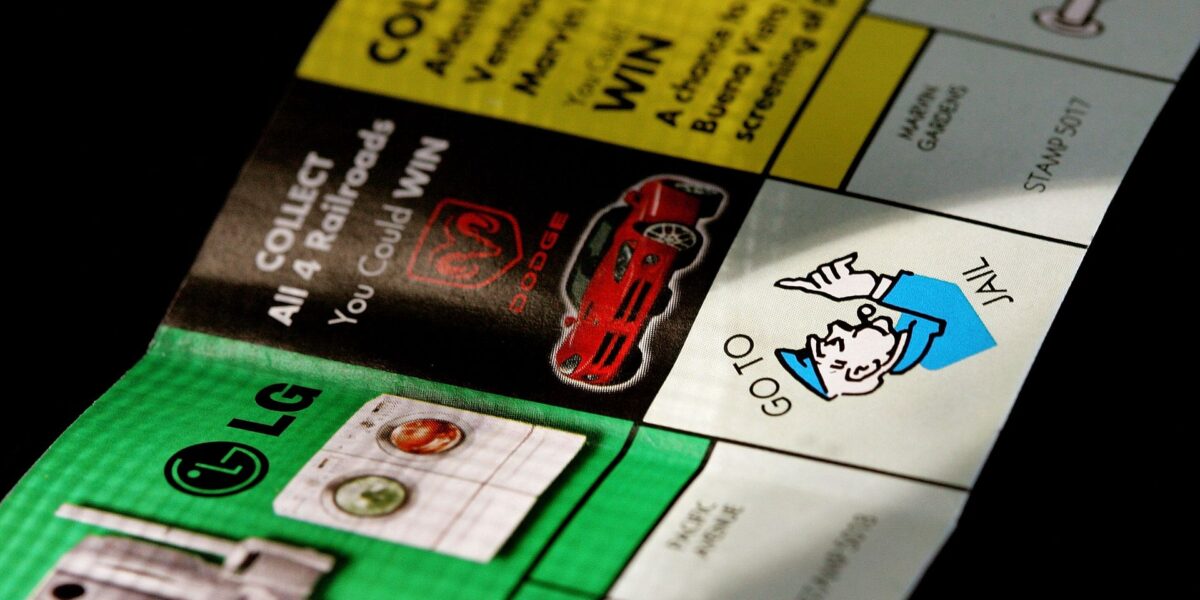
The McDonald’s Monopoly game launched in 1987. Customers collected peel-off game pieces from food packaging — each piece representing a property on the Monopoly board — and won prizes by completing color-coded sets. The top prize required landing both dark blue properties: Park Place and Boardwalk.
Simon Marketing handled the logistics: printing the pieces, overseeing their distribution to packaging facilities, and administering prize claims. The high-value pieces — the ones worth $1 million — were treated with extraordinary security. They were stored in a locked safe requiring multiple employees to open simultaneously, transported in tamper-evident cases, and placed in the custody of Simon’s security director.
That was Jacobson, a former Florida police officer who had left the force after developing a severe nerve condition. He had built a sterling reputation at Simon — he was the man who had his own staff’s shoes searched daily, the man described by colleagues as incorruptible. McDonald’s had no reason not to trust him with the pieces. He had been the one, after all, who designed the trust-but-verify protocols.
The scheme began, according to court records, when a supplier accidentally sent Jacobson a sheet of the anti-tamper security seals used to close the winning-piece packages during transit. With both the pieces and the seals in his possession, Jacobson realized he could remove winning pieces from the system, reseal the packages as if they had never been opened, and redirect the prizes wherever he chose. No one would ever know.¹
Building a Criminal Franchise
Jacobson’s first beneficiaries were friends and family. But the operation rapidly professionalized. His most consequential early contact was Gennaro “Jerry” Colombo — an associate of the Colombo crime family whom Jacobson met by chance — who became his primary broker, recruiting fake winners and handling the financial mechanics of the kickbacks. Each “winner” would keep a portion of the prize and return the rest, in cash, up the chain to Jacobson.
When Colombo died in 1998, Jacobson reorganized. His network by then included Dwight and Linda Baker, a Mormon real-estate developer couple from Georgia; a cluster of winners in Jacksonville, Florida, where Jacobson had previously worked; and eventually more than fifty people spread across the country. The operation covered not just the Monopoly game but other McDonald’s promotions, including the “Who Wants to Be a Millionaire” game. Between 1995 and 2001, Jacobson’s associates claimed more than $24 million in cash and prizes — including multiple $1 million awards, cars, and vacations — all of which were won by people he had personally selected.²
The scheme was not perfectly hidden. It was simply never looked for. Investigators would later note that the geographic clustering of winners near Jacobson’s home in Georgia and his former workplace in Florida was obvious in retrospect. One family claimed three separate $1 million prizes plus a Dodge Viper. Nobody at McDonald’s or Simon Marketing noticed.
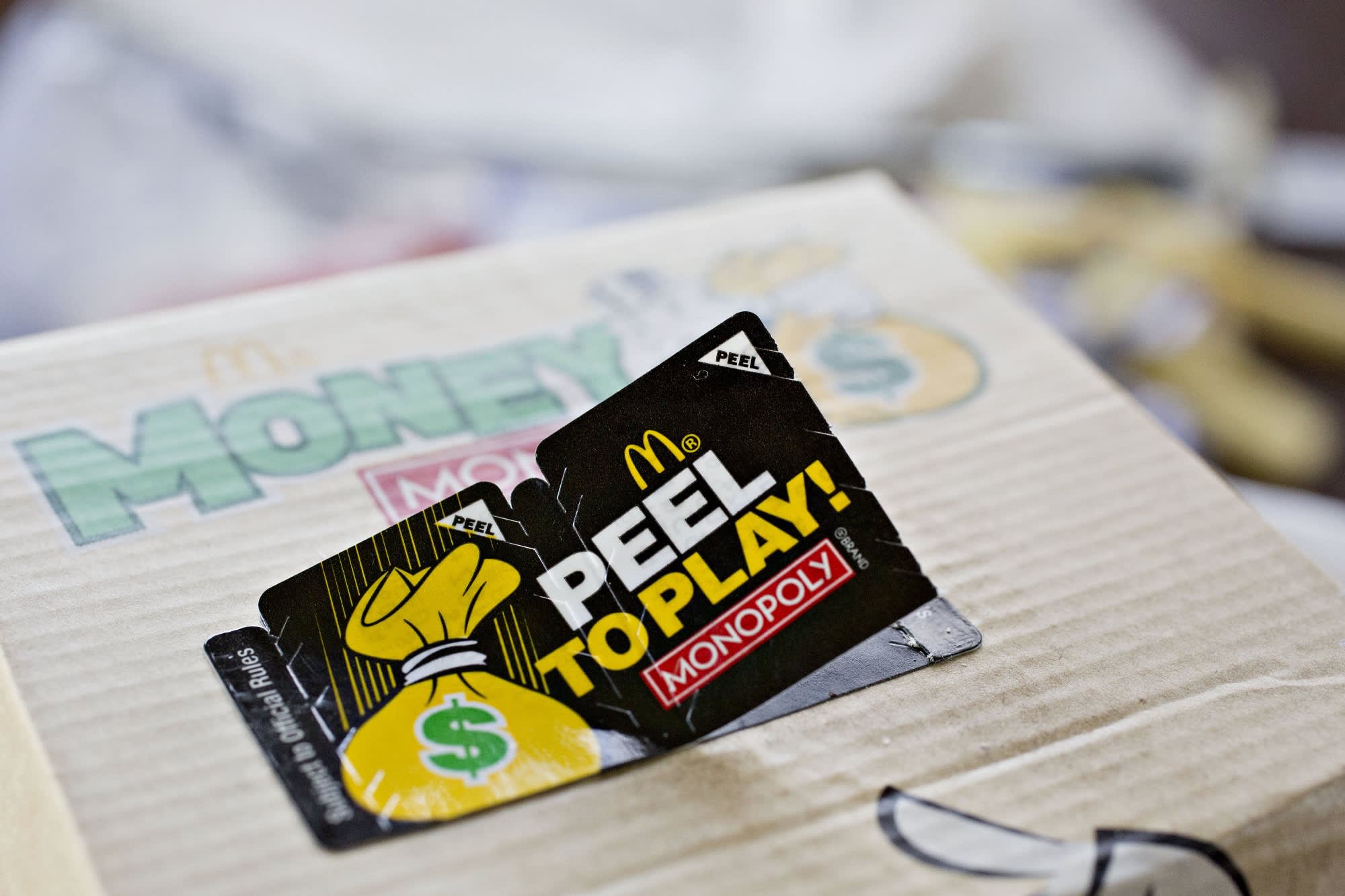
Game pieces for the McDonald’s Monopoly fame affixed to a hamburger box. (Public Domain)
Operation Final Answer
The first break came in early 2001, when the FBI’s Jacksonville field office received an anonymous tip: all the high-value McDonald’s contest prizes were going to the same small group of people, and a man called “Uncle Jerry” was at the center of it. Special Agent Doug Dent opened an investigation he named Operation Final Answer — after another McDonald’s promotional game — and began building a case with characteristic patience.
The operation eventually involved twenty-five agents tracking 20,000 phone numbers and filling 235 cassette tapes with recorded calls.³ But its signature moment was a sting operation conceived by Agent Doug Matthews, who proposed posing as a McDonald’s commercial production crew to interview suspicious winners on camera — with the ostensible purpose of filming a feel-good promotional video about how they had found their pieces.
On August 3, 2001, the fake crew arrived at the home of Michael Hoover, a $1 million “winner.” Hoover gave a detailed and unknowing account of his fraud directly into the FBI’s cameras. Eighteen days later, on August 21, federal agents fanned out across the country before dawn and arrested eight people, including Jacobson himself. His bond was set at $1 million.⁴
Attorney General John Ashcroft, announcing the arrests, said: “Those involved in this type of corruption will find out that breaking the law is no game.”⁵
The Reckoning — and the Footnote
The trial began on September 10, 2001. The next morning, the September 11 attacks occurred, and the McDonald’s Monopoly fraud largely vanished from the news for the next two decades.
The prosecutions ground on regardless. By the time the last plea was entered, 53 people had been indicted and 48 had pleaded guilty, including 46 in pretrial plea agreements.⁶ Jacobson himself pleaded guilty to three counts of mail fraud in federal court in Jacksonville and was sentenced to 37 months in federal prison and more than $12.5 million in restitution. McDonald’s severed its relationship with Simon Marketing. Both companies sued each other for breach of contract; the suits were settled out of court, with Simon receiving $16.6 million.
Four putative winners who had been convicted of fraud had their convictions reversed on appeal on the grounds that they had not known the pieces were stolen — that they were, in the eyes of the court, themselves victims of a fraud that operated at one remove from their knowledge.⁷
What the case revealed, in the analysis of a subsequent academic study published through Oxford University’s research archive, was less a story of one man’s greed than a comprehensive failure of internal controls — a case study in what happens when the person responsible for the integrity of a system is given sole, unsupervised access to its most sensitive components.⁸ McDonald’s had outsourced the contest to Simon. Simon had hired Jacobson. Nobody had designed a mechanism to catch the person at the top of the security chain, because nobody had imagined that the person at the top of the security chain was the threat.
Jacobson, now in his eighties, reportedly lives quietly in Atlanta and declines to discuss the scheme. His network included mobsters and Mormons, drug traffickers and true believers, people who spent their kickbacks on surgery and cars and vacations and people who went to prison for their association with a man they knew only as Uncle Jerry. He had once dreamed of becoming a police officer. He became, instead, the most successful fraudster in the history of promotional marketing — a man who beat the house so thoroughly, for so long, that the house never noticed until someone called the FBI.
Endnotes
¹ U.S. Department of Justice, Office of Public Affairs, “Eight Arrested for Defrauding McDonald’s Corp. and Its Customers in Promotional Prize Contests,” press release no. 422, August 21, 2001, https://www.justice.gov/archive/opa/pr/2001/August/422ag.htm. The anti-tamper seal origin story — a supplier accidentally providing Jacobson the seals — is detailed in court records cited in CNBC, “How the ‘McMillions’ Scammers Rigged McDonald’s Monopoly Game and Stole $24 Million,” February 7, 2020, https://www.cnbc.com/2020/02/07/how-mcmillions-scam-rigged-the-mcdonalds-monopoly-game.html.
² DOJ press release, August 21, 2001; CNBC, February 7, 2020. The $24 million total and the scope of games covered — Monopoly, “Who Wants to Be a Millionaire,” and other McDonald’s promotions — are confirmed in both sources. The figure of more than $13 million in grand prizes had already been documented at the time of the initial August 2001 arrests; the total of $24 million reflects the full scope confirmed by the end of prosecutions.
³ The 25-agent team, 20,000 phone numbers, and 235 cassette tapes are reported in CNBC, February 7, 2020, drawing on court documents.
⁴ The fake McDonald’s film-crew sting and the August 3 Hoover interview are described in Brian Lazarte and James Lee Hernandez, directors of McMillions (HBO, 2020), interviewed by Renée Montagne, Morning Edition, NPR, February 1, 2020, https://www.npr.org/2020/02/01/801832865/mcmillions-how-the-ex-cop-who-scammed-mcdonalds-monopoly-got-caught. The August 21, 2001, arrest date and Jacobson’s $1 million bond are confirmed in the DOJ press release, August 21, 2001.
⁵ Attorney General John Ashcroft, quoted in DOJ press release, August 21, 2001.
⁶ The final prosecutorial totals — 53 indicted, 48 guilty pleas, 46 pretrial — are documented in T. Chilton, “McDonald’s Monopoly Fraud Case,” academic case study, Oxford University Research Archive, 2024, https://ora.ox.ac.uk/objects/uuid:2fce6717-11ed-4f89-be74-a91c395ea8aa. Jacobson’s sentence of 37 months and $12.5 million restitution is confirmed in CNBC, February 7, 2020.
⁷ The four reversed convictions — on the grounds that those winners had not known the pieces were stolen — are documented in Chilton, Oxford University Research Archive, 2024, and confirmed in CNBC, February 7, 2020.
⁸ Chilton, “McDonald’s Monopoly Fraud Case,” Oxford University Research Archive, 2024. The paper, which uses the McDonald’s case as a study in Committee of Sponsoring Organizations (COSO) internal control failures, is held in the Oxford University Research Archive and uses the case to illustrate “control system shortcomings” stemming from Jacobson’s unchecked authority over the game’s most sensitive components.