

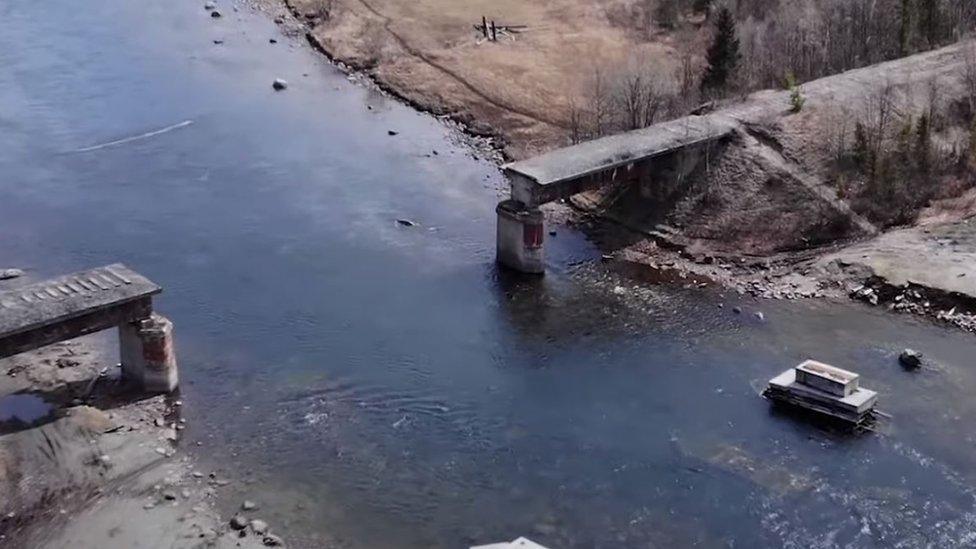
Kenneth Morrison had been staring at that bridge for twenty-three years.
The Monon Bridge in Hammond, Indiana, was not much to look at by the time Morrison started circling it seriously. Built in 1910 to carry freight across the Grand Calumet River for the Hammond Meatpacking Company, it had been out of service for decades. CSX Railroad had donated it to the city of Hammond in 1987 with no clear plan for what the city might do with it, and Hammond — facing the same fiscal pressures as every post-industrial city in the Rust Belt — had done nothing in particular. The drawbridge sat rusting in its channel north of downtown, unused and apparently unloved, its steel slowly oxidizing above the river while the city held indifferent title to it.
Morrison, who ran a scrap metal business called T&K Metals out of nearby Whiting, saw something different. He saw value — raw, practical, cashable value. A bridge built in 1910 was an accumulation of structural steel, and structural steel, sold by the ton to Illinois scrapyards, was money. He first approached the city in 1991 to ask permission to purchase and dismantle it. The city said no. He approached the Board of Public Works and Safety again in September 2014, arguing this time that the bridge sat on railroad land and he was in negotiations with the railroad to buy it. The city said no again.¹
Morrison dismantled it anyway.
The Operation
Between December 2014 and January 2015 — over roughly two months, in the middle of an Indiana winter — Morrison and a crew of workers arrived at the Grand Calumet River with cutting equipment and began methodically reducing the Monon Bridge to transportable pieces. They worked without permits, without authority, and without, apparently, much concern about being observed. Nobody came. Nobody called the city. Nobody called the police. The bridge came apart piece by piece, loaded onto trucks, and was driven across the state line to a scrapyard in Burnham, Illinois, where it was sold. Additional pieces went to a scrap dealer in East Chicago, Indiana.
Total proceeds: $18,000.²
The bridge that had stood since 1910 — one of only two remaining drawbridges in the region, the last surviving remnant of the Hammond Meatpacking era, a structure that federal prosecutors would later note was eligible for listing on the National Register of Historic Places — was gone. What remained were the bridge’s supports and, as inspectors from the Indiana Department of Environmental Management discovered months later, a significant quantity of contaminated material Morrison’s crew had left in the river during the dismantling.³
The crime might have gone undetected entirely, had an Indiana Department of Natural Resources conservation officer not stumbled onto the scene mid-operation and ordered Morrison to stop. He stopped — temporarily. The bridge was already largely gone.
The Man, the Motive, and the Prior
Morrison was not a mysterious figure or a shadowy operator. He had been in the scrap business his entire adult life, he told the court, and the logic of the Monon Bridge was straightforward to him: it was a large piece of idle metal with an uncertain owner, sitting in a city that had done nothing with it for twenty-seven years. He had asked twice. They had said no twice without adequately explaining, in his view, what they were protecting or why. The deed Hammond received from CSX in 1987 had not even been recorded with the county for more than three decades.⁴
It was not his first confrontation with the law over salvage work. In 1995, Morrison had served prison time and paid $50,000 in fines after accidentally spilling 2,000 gallons of waste oil into the Schuylkill River in Pennsylvania and another 3,000 gallons into the ground while attempting to salvage a metal tank. He returned to the scrap business afterward.⁵ The federal jury that heard his case in December 2018 was apparently not persuaded that two formal refusals from the city of Hammond constituted ambiguity about ownership.
The conviction was for interstate transportation of stolen property — the bridge having been driven across the Indiana-Illinois state line. U.S. District Court Judge Philip P. Simon sentenced Morrison in September 2019 to twenty-four months in federal prison, two years of supervised release, and more than $54,000 in restitution to the city of Hammond. The sentence was enhanced, prosecutors noted, because of the bridge’s eligibility for the National Register of Historic Places — a historic preservation overlay that turned a straightforward theft into a federally aggravated one.⁶
“I’ve been scrapping all my life,” Morrison told the court at sentencing. “I take down railroad tracks and bridges all the time.”⁷
What It Cost to Build, What It Cost to Lose
The restitution figure — $54,000 — reflects the replacement cost of what Morrison had sold for $18,000. The broader context is more dispiriting. The Monon Bridge was not a piece of infrastructure that the city needed for traffic. It was not blocking anything or serving anyone. But it was a surviving piece of a regional industrial history that no longer has many surviving pieces, and the reason it no longer exists is not neglect or development or a considered demolition decision. It was cut apart on winter nights by a man with a blowtorch who had done the math on scrap prices and concluded, correctly, that no one was watching closely enough to stop him.
He was right for approximately two months. Then he was wrong for the rest of it.
Endnotes
¹ U.S. Department of Justice, U.S. Attorney’s Office, Northern District of Indiana, “Whiting Man Convicted After 4-Day Jury Trial,” press release, December 13, 2018, https://www.justice.gov/usao-ndin/pr/whiting-man-convicted-after-4-day-jury-trial. Morrison’s 1991 and 2014 permit applications to the Hammond Board of Public Works and Safety are documented in this release and in the Chicago Tribune‘s sentencing report: Jorge Enrique Matos, “Whiting Man Convicted of Stealing Hammond Bridge Built in 1910 Sentenced to 24 Months, Ordered to Pay Restitution,” Chicago Tribune, September 6, 2019, https://www.chicagotribune.com/suburbs/post-tribune/ct-ptb-hammond-bridge-st-0907-20190906-ywvr2tdttreajbph5nlydllsqm-story.html.
² DOJ press release, December 13, 2018: “without authority the defendant dismantled the Monon Bridge in Hammond, Indiana, and transported pieces of the bridge to Burnham, Illinois where he sold the scrap for $18,000. He also sold parts of the bridge to a scrap dealer in East Chicago, Indiana.”
³ The bridge’s construction date, its donation to Hammond by CSX (formerly CFX Railroad) in 1987, its status as one of only two remaining drawbridges in the region, and its eligibility for the National Register of Historic Places are established in the DOJ sentencing press release: U.S. Department of Justice, U.S. Attorney’s Office, Northern District of Indiana, “Whiting Man Sentenced to Prison and Ordered to Pay Restitution to the City of Hammond,” press release, September 6, 2019, https://www.justice.gov/usao-ndin/pr/whiting-man-sentenced-prison-and-ordered-pay-restitution-city-hammond. The IDEM environmental violations — contaminated material left in the Grand Calumet River — are documented in the Times of Northwest Indiana‘s trial coverage, cited in “Man Convicted of Razing Indiana Bridge for Scrap Gets Prison,” The Indiana Lawyer, September 6, 2019, https://www.theindianalawyer.com/articles/man-convicted-of-selling-historic-bridge-for-scrap-gets-prison.
⁴ The unrecorded deed — Hammond held title from 1987 but did not record it with the county for more than thirty years — is reported in Chicago Tribune, September 6, 2019. Defense attorney Sheldon Nagelberg’s abandonment argument, and the prosecution’s rebuttal that Morrison’s own permit applications proved he knew Hammond owned the bridge, are documented in both the Chicago Tribune and the Associated Press account: “Man Convicted of Razing Indiana Bridge for Scrap Gets Prison,” AP/WANE-TV, September 6, 2019, https://www.wane.com/news/indiana/man-convicted-of-razing-indiana-bridge-for-scrap-gets-prison/.
⁵ Morrison’s 1995 prison sentence and $50,000 fine for the Schuylkill River waste oil spill are reported in the Times of Northwest Indiana, cited in “Scrap Metal Dealer Asks for New Trial in Monon Bridge Theft Case,” Times of Northwest Indiana, https://www.nwitimes.com/news/local/crime-courts/scrap-metal-dealer-asks-for-new-trial-in-monon-bridge/article_f0d623a2-b0a7-5db7-94ff-b44e31296386.html. The prior conviction is also referenced in Hammond Historical Society records cited in the same account.
⁶ Sentence details — 24 months, 2 years supervised release, $54,000 restitution, and the historic preservation enhancement — are confirmed in the DOJ sentencing press release, September 6, 2019, and corroborated in Chicago Tribune, September 6, 2019.
⁷ Morrison, quoted at sentencing in “Man Convicted of Razing Indiana Bridge for Scrap Gets Prison,” The Indiana Lawyer, September 6, 2019, and AP/WANE-TV, September 6, 2019.