

Human beings are generally terrible at understanding deep time. We sort things intuitively — ancient, medieval, modern — and assume the categories correspond to roughly equal spans of history. They do not. The past is not a neat procession; it is a vast, lurching thing full of overlaps, inversions, and coincidences that flatly contradict our mental model of how time works. What follows are ten facts that demonstrate exactly that — arranged in order of increasing disorientation.
The assumption seems safe enough: great universities and modern science arrived together, products of the same Enlightenment ferment. And yet Harvard University was chartered by the Massachusetts General Court in 1636 — more than fifty years before Isaac Newton published Philosophiae Naturalis Principia Mathematica in 1687, the work that gave the world calculus, the laws of motion, and the mathematical description of universal gravitation.¹
When Harvard’s first students were studying theology in Cambridge, Massachusetts, the scientific framework that would underpin all of modern physics did not yet exist. The apple, as it were, had not yet fallen. Newton himself was a six-year-old living in Lincolnshire, England, the year Harvard opened its doors. The university that would one day teach quantum mechanics and astrophysics was educating its first class in a world that had no coherent mathematical description of how objects fall.
Alexander Graham Bell received his patent for the telephone in 1876. By then, the fax machine had already existed for thirty-three years.
In 1843, a Scottish clockmaker and inventor named Alexander Bain received a British patent for a device capable of transmitting a two-dimensional image over telegraph wires by scanning a surface with a stylus mounted on a synchronized pendulum. The concept was, functionally, a fax machine. The first commercial facsimile service — operating between Paris and Lyon — launched in 1863, built by Italian inventor Giovanni Caselli using Bain’s underlying principles. As Jonathan Coopersmith, Associate Professor of History at Texas A&M University, documents in his authoritative history of fax technology, that service ran for a decade before Bell placed a single telephone call.² When Bell famously said “Mr. Watson — come here — I want to see you” in 1876, the technology for sending documents electronically had already been commercially deployed and commercially abandoned once.
When people think of Nintendo, they think of Mario, Zelda, the NES, the Game Boy — artifacts of late-twentieth-century pop culture. The company’s origins feel as recent as all of that. In fact, Nintendo was founded by craftsman Fusajiro Yamauchi on September 23, 1889, in Kyoto, Japan, to manufacture handmade hanafuda — traditional Japanese flower cards.³
The Eiffel Tower, that enduring symbol of modernity and the industrial age, opened on May 15 of that same year, erected for the Paris Exposition Universelle. As historian Jill Jonnes documents in her account of the tower’s construction, Gustave Eiffel’s workers were still completing the final stages of the structure when Yamauchi was sourcing mulberry bark for his first deck of playing cards.⁴ The company that would one day make Donkey Kong is essentially as old as the most famous iron structure on Earth. Both were born in 1889 and have outlasted almost everything else from that year.
On May 25, 1977, Star Wars opened in thirty-two American theaters and began its conquest of popular culture. Four months later, on September 10, 1977, a man named Hamida Djandoubi was led from Baumettes Prison in Marseille in the hours before dawn and beheaded by a falling blade. He was the last person executed by guillotine in France — and, as it turned out, in the world.
France abolished capital punishment entirely in 1981, and the guillotine became a museum piece. But for a single, surreal calendar year, the galaxy far, far away and the Enlightenment’s most industrialized method of execution coexisted in the same world. The most vivid account of Djandoubi’s final minutes comes from Monique Mabelly, the examining magistrate appointed to witness the execution, whose document — entrusted to her son and eventually passed to former French Justice Minister Robert Badinter — was published in English translation in Harper’s Magazine in 2014. She describes the guards laying brown blankets on the corridor floor to muffle their footsteps, the silence of the hall, the machine waiting at the end.⁵
The Aztec civilization — with its pyramids, its sacrificial calendars, its capital city of Tenochtitlán rising from a lake in the Valley of Mexico — occupies a firm place in the popular imagination as something ancient, belonging to a world utterly unlike our own. And yet when the Aztecs founded Tenochtitlán in 1325, the University of Oxford had already been operating for more than two centuries. As Oxford’s own institutional records document, teaching there existed in some form as early as 1096, and grew rapidly after 1167, when Henry II banned English students from attending the University of Paris.⁶
By the time the first Aztec priests laid the foundations of their great temple, Oxford had fully established colleges — University, Balliol, and Merton — each with its own charter and endowment. As Smithsonian Magazine noted in a 2024 feature on the comparison, Oxford predates not only the Aztec Empire but the printing press, the Renaissance’s full flowering, and the Ottoman Empire.⁷ It is not merely old. It was ancient while the Americas were still beyond the horizon of European knowledge.
The Holocaust and the American civil rights movement are typically taught as separate historical phenomena, separated not just by geography but by a sense of historical distance — the one belonging to the catastrophe of World War II, the other to the television age and the long struggle for American democracy. It is startling, then, to note that Anne Frank was born on June 12, 1929, and Martin Luther King Jr. was born on January 15, 1929 — the same calendar year, five months apart.⁸
Frank died at Bergen-Belsen in February or March 1945, at fifteen or sixteen years old. King was assassinated in Memphis in April 1968, at thirty-nine. Had she survived, Anne Frank could have watched King’s “I Have a Dream” speech on live television at the age of thirty-four. She might have watched the moon landing. The two figures feel separated by an ocean of history; they were separated by five months of the same year.
Julius Caesar is a figure of deep antiquity — ancient Rome, togas, the Ides of March, the Republic in its final convulsions. As Adrian Goldsworthy establishes in his Yale University Press biography, Caesar was born around 100 BCE and assassinated on March 15, 44 BCE.⁹ To Caesar, the Great Pyramid of Giza was already a monument of breathtaking antiquity: as Mark Lehner and Zahi Hawass document in their definitive study of Giza, the pyramid was completed around 2560 BCE, roughly 2,500 years before Caesar’s birth.¹⁰
Caesar is to us approximately 2,069 years in the past. The Great Pyramid was approximately 2,516 years in the past when Caesar walked beneath it. This means that the pyramid was more ancient to Julius Caesar than Julius Caesar is to us. The monument that tourists photograph today as a relic of antiquity was, for one of antiquity’s most famous inhabitants, itself a relic — something whose builders had been dead for as long ago as Caesar is dead now. Everything Caesar thought of as ancient history is, by that same measure, recent.
We tend to assume woolly mammoths belong to a world of ice sheets and cave paintings — something like 10,000 years in the past, long before anything we would recognize as civilization. This is mostly true of the mainland populations, which did indeed disappear around 10,000 years ago as the last Ice Age ended. But a small isolated population on Wrangel Island, a remote patch of land in the Arctic Ocean off the northeastern coast of Siberia, survived well into the historical era.
A 2024 genomic analysis published in the peer-reviewed journal Cell, led by Marianne Dehasque and colleagues, examined the genomes of the Wrangel Island mammoths in unprecedented detail and confirmed that the population persisted until approximately 4,000 years ago — around 2000 BCE, and possibly as recently as 1650 BCE.¹¹ The Great Pyramid was completed around 2560 BCE. Somewhere between those two dates — as Khufu’s tomb was being sealed, as Egyptian scribes were writing on papyrus, as Bronze Age civilizations were trading across the Mediterranean — a few hundred woolly mammoths were still grazing on an Arctic island, alive and apparently unaware that they were supposed to be extinct already.
This one requires a moment to absorb. Tyrannosaurus rex and Stegosaurus are, in the popular imagination, more or less contemporaries — the dinosaurs, in a lump. Museums put them in the same dioramas. Children’s toys put them in the same sandbox.
In reality, as the American Museum of Natural History states plainly in its public educational materials, Stegosaurus was extinct for approximately 66 million years before Tyrannosaurus walked on Earth.¹² Stegosaurus lived during the Late Jurassic period, approximately 150 million years ago. T-Rex lived during the Late Cretaceous, approximately 68 to 66 million years ago. The temporal gap between them — roughly 82 million years — is larger than the gap between T-Rex and us, which is approximately 66 million years. T-Rex is, in geological terms, more our contemporary than it was Stegosaurus’s.
As science writer Brian Switek explained in Smithsonian Magazine, the popular conflation of all dinosaurs into a single undifferentiated prehistoric era compresses tens of millions of years of evolution and extinction into a single mental category — one of the more spectacular failures of intuitive historical reasoning.¹³ When you see a diorama of T-Rex and Stegosaurus in combat, you are looking at a fiction roughly as anachronistic as a Roman soldier fighting a woolly mammoth.
Here it is: the one that collapses everything.
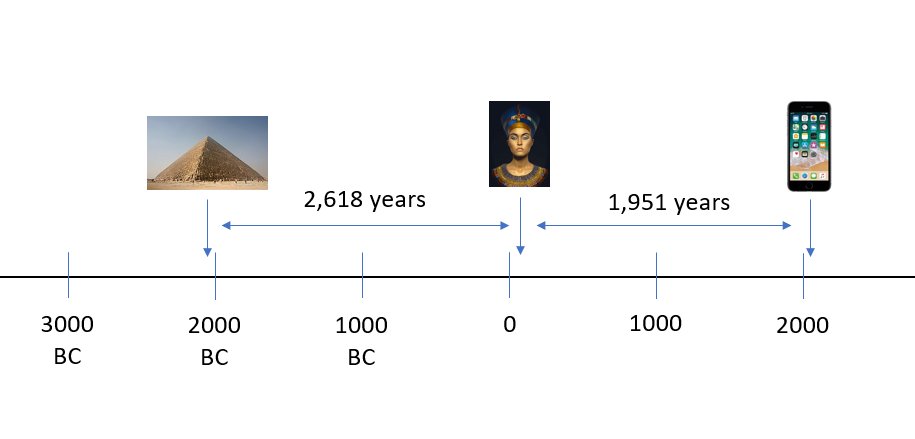
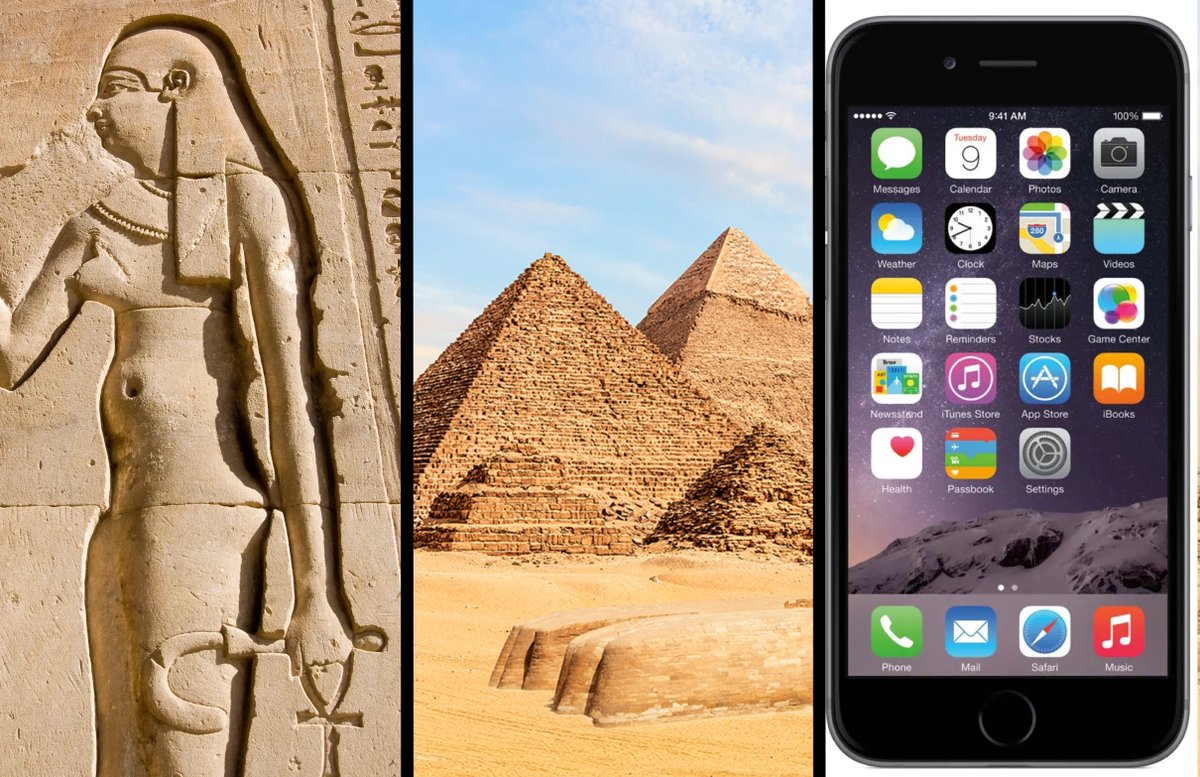
Cleopatra VII — last pharaoh of Egypt, lover of Julius Caesar and Mark Antony, symbol of ancient civilization — was born in approximately 69 BCE and died in 30 BCE, as Pulitzer Prize-winning historian Stacy Schiff establishes in her biography Cleopatra: A Life.¹⁴ The Great Pyramid of Giza was completed around 2560 BCE, as documented by Lehner and Hawass.¹⁵ Apple’s iPhone was introduced by Steve Jobs at the Macworld Conference and Expo in San Francisco on January 9, 2007.¹⁶
The arithmetic is straightforward and deeply disorienting. The gap between the Great Pyramid and Cleopatra’s death is approximately 2,491 years. The gap between Cleopatra’s death and the iPhone is approximately 2,037 years. Cleopatra was closer in time to the iPhone than she was to the construction of the monument that most defines her civilization’s visual identity.
She was not a woman of antiquity gazing back reverently at immemorial history. She was a woman standing closer to the middle of the story than to its beginning, looking back at a structure that was already ancient when ancient Rome was young. For Cleopatra, the pyramids were as old as the Norman Conquest is to us. To her, Khufu was history.
What this means, if you follow the implication all the way down, is that our entire intuitive sorting of “ancient” and “modern” is deeply wrong. We place Cleopatra in a world of pyramids and pharaohs because she shares the category of “ancient Egypt” with both. But she shares a closer temporal neighborhood with Leonardo da Vinci, the printing press, and the fall of Constantinople than she does with Khufu. Time is not a set of neat eras. It is a continuous line, and almost nothing we learned in school prepared us for how long that line actually is.
Endnotes
¹ Harvard University’s founding charter is dated October 28, 1636, by the Massachusetts General Court; see Harvard University, “History,” https://www.harvard.edu/about/history/. Newton’s Principia was first published in July 1687; for the publication history and scholarly context, see I. Bernard Cohen and Anne Whitman, trans., The Principia: Mathematical Principles of Natural Philosophy, by Isaac Newton (Berkeley: University of California Press, 1999), 1–6, 380–83.
² Jonathan Coopersmith, “Fax Machines,” Engineering and Technology History Wiki (IEEE), last updated June 14, 2018, https://ethw.org/Fax_Machines. Coopersmith is Associate Professor of History, Texas A&M University, and the author of Faxed: The Rise and Fall of the Fax Machine (Baltimore: Johns Hopkins University Press, 2015). Alexander Bain’s 1843 patent is confirmed therein, along with the Caselli Paris–Lyon commercial service of 1863.
³ Nintendo Co., Ltd., “Nintendo History,” Nintendo (corporate website), https://www.nintendo.com/en-gb/Hardware/Nintendo-History/Nintendo-History-625945.html. The founding date of September 23, 1889, and Yamauchi’s production of hanafuda playing cards are confirmed on Nintendo’s official institutional record.
⁴ Jill Jonnes, Eiffel’s Tower: And the World’s Fair Where Buffalo Bill Beguiled Paris, the Artists Quarreled, and Thomas Edison Became a Count (New York: Viking, 2009), 3–10. Jonnes, a National Endowment for the Humanities scholar, gives the opening date as May 15, 1889, confirmed in the review of the book by France Today (September 2010), https://francetoday.com/learn/books/eiffel_and_the_fair/.
⁵ Monique Mabelly, “This Will Be the Last,” trans. Ryann Liebenthal, Harper’s Magazine, February 2014, https://harpers.org/archive/2014/02/this-will-be-the-last/. Mabelly was the juge d’instruction appointed to witness the Djandoubi execution on September 10, 1977; she entrusted the document to her son, who passed it to Badinter, who provided it to Harper’s for publication.
⁶ University of Oxford, “History of the University,” official institutional page, https://www.ox.ac.uk/about/organisation/history: “There is no clear date of foundation but teaching existed at Oxford in some form in 1096 and developed rapidly from 1167.” The banning of English students from Paris by Henry II is established in the same institutional account.
⁷ Meilan Solly, “The University of Oxford Is Older Than the Aztec Empire,” Smithsonian Magazine, November 5, 2024, https://www.smithsonianmag.com/smart-news/university-oxford-older-than-aztec-empire/. The Aztec founding of Tenochtitlán in 1325 is the conventional date established in Michael E. Smith, The Aztecs, 3rd ed. (Oxford: Wiley-Blackwell, 2011), 38–42, the standard academic reference on Aztec history.
⁸ Anne Frank’s birth date of June 12, 1929, is documented by the Anne Frank House, Amsterdam: Anne Frank House, “Anne Frank’s Biography,” https://www.annefrank.org/en/anne-frank/biography/. Martin Luther King Jr.’s birth date of January 15, 1929, is established in Taylor Branch, Parting the Waters: America in the King Years, 1954–63 (New York: Simon & Schuster, 1988), 57 — the Pulitzer Prize-winning biography, the standard scholarly account of King’s life and career.
⁹ Adrian Goldsworthy, Caesar: Life of a Colossus (New Haven: Yale University Press, 2006), 1–3, 476–85. Goldsworthy, who read history at Oxford and is the leading English-language biographer of Caesar, places his birth at c. 100 BCE and death at March 15, 44 BCE. The book was selected as an Outstanding Academic Title for 2007 by Choice and cited in the New York Times Book Review as “authoritative.”
¹⁰ Mark Lehner and Zahi Hawass, Giza and the Pyramids: The Definitive History (Chicago: University of Chicago Press, 2017), 18–22. Lehner and Hawass are the two most active and well-respected archaeological scholars to have worked at Giza in the modern era. The University of Chicago Press calls this “the most comprehensive survey of the Giza Plateau ever published.” The construction date of c. 2560 BCE rests on a convergence of radiocarbon dating, king-list chronologies, and archaeological stratigraphy detailed in this volume.
¹¹ Marianne Dehasque et al., “Temporal Dynamics of Woolly Mammoth Genome Erosion Prior to Extinction,” Cell 187, no. 14 (July 11, 2024): 3531–45, https://doi.org/10.1016/j.cell.2024.05.033. The study examined 23 Wrangel Island mammoth genomes spanning the population’s entire history and confirmed survival to approximately 4,000 years ago, likely as late as c. 1650 BCE.
¹² American Museum of Natural History, “Dinosaur FAQ,” AMNH, https://www.amnh.org/dinosaurs/faq: “Stegosaurus was extinct for 66 million years before Tyrannosaurus walked on Earth.” The AMNH is the world’s preeminent natural history museum and the home institution of the paleontological research underlying these dates.
¹³ Brian Switek, “On Dinosaur Time,” Smithsonian Magazine, November 17, 2013, https://www.smithsonianmag.com/science-nature/on-dinosaur-time-65556840/. Switek, a science journalist and author of My Beloved Brontosaurus (Scientific American/FSG, 2013), discusses the temporal separation between major dinosaur groups and the popular conflation of all Mesozoic life into a single era.
¹⁴ Stacy Schiff, Cleopatra: A Life (New York: Little, Brown, 2010), 1–3, 297–305. Schiff — winner of the Pulitzer Prize in Biography for Véra (Mrs. Vladimir Nabokov) — places Cleopatra’s birth at approximately 69 BCE and death at 30 BCE. The book won the PEN/Jacqueline Bograd Weld Award for Biography and was named a Top Ten Book of the Year by the New York Times.
¹⁵ Lehner and Hawass, Giza and the Pyramids, 18–22.
¹⁶ Apple Inc., “Apple Reinvents the Phone,” press release, January 9, 2007, https://www.apple.com/newsroom/2007/01/09Apple-Reinvents-the-Phone/. The announcement was made by Steve Jobs at the Macworld Conference and Expo in San Francisco. The temporal calculation (Cleopatra’s death in 30 BCE to iPhone introduction in January 2007: ~2,037 years; Great Pyramid completion ~2560 BCE to Cleopatra’s death 30 BCE: ~2,491 years) is the author’s arithmetic from the scholarly dates cited in notes 14 and 15.