

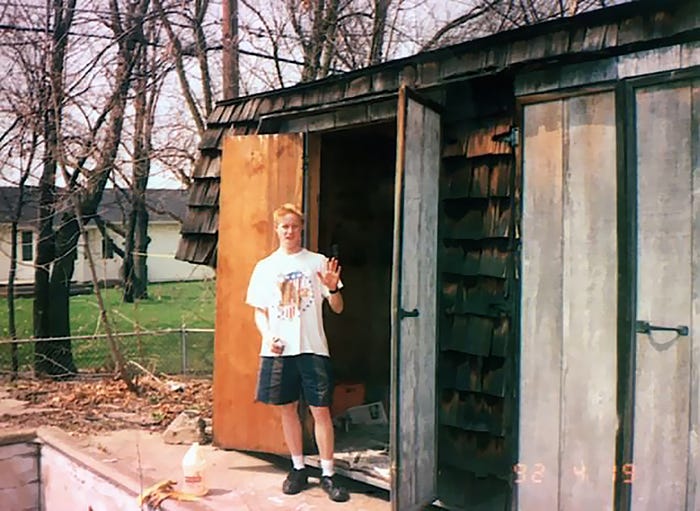
On the morning of June 26, 1995, the residents of Golf Manor subdivision in Commerce Township, Michigan, came home from work to an unusual sight: half a dozen men in white hazmat suits and respirators were methodically dismantling their neighbor’s garden shed with power saws. Steel drums emblazoned with radiation warning symbols were being loaded onto trucks. The Environmental Protection Agency workers on the scene offered vague reassurances. There was nothing to worry about. Everything was fine.
Everything was very much not fine. The shed had been contaminated with radioactive material by a seventeen-year-old Eagle Scout named David Hahn, who had spent the better part of two years trying to build a nuclear breeder reactor in his mother’s backyard — and who had, in the process, exposed up to 40,000 residents of the surrounding area to elevated levels of radiation.
The Making of a Teenage Nuclear Physicist
David Hahn did not fit any obvious profile of a dangerous person. He was gangly, blond, fascinated by chemistry, and something of a loner. His parents had divorced when he was a child, and he shuttled between his father’s house in Clinton Township and his mother’s house in Golf Manor. It was at his stepmother’s home that the trouble began, when Hahn was around ten years old, and her father gave him a copy of The Golden Book of Chemistry Experiments — a breezy, optimistic 1960 guide to amateur science that cheerfully recommended disposing of toxic chemical waste down the kitchen sink.¹
By twelve, Hahn had worked through his father’s college chemistry textbooks. By fourteen, he had synthesized nitroglycerin — discovered the hard way when an explosion in the basement left him semiconscious on the floor, his eyes requiring hospital treatment. His stepmother banned further experiments in her home. His father, hoping to give the boy some structure and direction, enrolled him in the Boy Scouts.
It did not have the intended effect. Working toward his Atomic Energy merit badge, Hahn became consumed by nuclear physics. He read everything he could find on breeder reactors — devices that produce more fissile material than they consume — and decided to build one himself. The goal, as he told journalist Ken Silverstein years later, was nothing less than solving the global energy crisis.²
Scavenging the Atom
What followed was an extraordinary feat of resourcefulness, recklessness, and regulatory failure in roughly equal measure. Hahn needed radioactive material. He obtained it by dismantling thousands of household smoke detectors to extract trace amounts of americium-241. He collected gas lantern mantles for thorium. He bought antique clocks and instrument dials for their radium paint. He purchased a thousand dollars’ worth of lithium batteries and extracted the lithium himself.
For technical guidance, he called and wrote to nuclear industry professionals and government agencies, posing as an adult researcher or, when that seemed insufficient, a high school physics teacher. The Nuclear Regulatory Commission, Silverstein later reported with some astonishment, became his most reliable source of technical information.³ His letters contained spelling errors and elementary scientific mistakes that should have flagged him immediately as something other than a credentialed professional. Nobody looked closely enough to notice.
Working in the cramped garden shed in his mother’s backyard — wearing a secondhand dentist’s lead apron as his primary safety equipment, carefully throwing away the clothes he wore during experiments — Hahn eventually constructed a crude neutron source. It never came close to achieving the self-sustaining reaction of a true breeder reactor. What it did do, according to later EPA measurements, was emit radiation at levels likely exceeding one thousand times the normal background rate.⁴
The End of the Experiment
The project unraveled in August 1994, when Hahn was stopped by police investigating a separate matter — a neighborhood dispute over stolen tires. Officers noticed suspicious material in his car. When Hahn warned them it was radioactive, they contacted federal authorities. What began as a routine traffic stop triggered a Federal Radiological Emergency Response involving the FBI, the Nuclear Regulatory Commission, and eventually the EPA.
By June 1995, the EPA had designated Hahn’s mother’s property a Superfund hazardous materials cleanup site. Workers dismantled the shed entirely, packing its remains into 39 sealed steel drums that were shipped to a low-level radioactive waste burial site in the Utah desert. What the EPA did not know — and would not discover until later — was that Hahn’s mother, terrified of losing her house, had already quietly gathered up the majority of his radioactive stockpile and thrown it into the ordinary household trash.⁵
Hahn refused medical evaluation. He attained his Eagle Scout rank shortly after the lab was dismantled.
What Came After
The story, as science writer Sam Kean noted in his 2010 book The Disappearing Spoon, was quickly sensationalized in press coverage that consistently overstated what Hahn had actually achieved. He had not built a functioning reactor. He had not come close to a critical mass. What he had built, Kean wrote, was a crude device that “threw off toxic levels of radiation” — dangerous enough to require a federal cleanup operation, but not the near-nuclear-bomb the headlines implied.⁶
The sadder story is what followed. Hahn joined the Navy, served, and returned to Michigan. In 2007, he was arrested for stealing smoke detectors from his apartment building — his mug shot showed a face covered in open sores that investigators believed were consistent with chronic radiation exposure.⁷ He pleaded guilty, received a sentence of time served plus psychiatric treatment, and died in 2016 at thirty-nine. The cause was an accidental combination of alcohol and medications.
Silverstein, who had written the original 1998 Harper’s Magazine investigation that brought Hahn’s story to national attention and later expanded it into a full book, described him as a profoundly isolated young man with no real mentorship — not from his fractured family, not from his teachers, not from the Scout leaders who signed off on his Atomic Energy badge. He was, Silverstein wrote, someone who genuinely believed he could change the world, armed with little more than a mail-order chemistry book, a dentist’s apron, and an extraordinary willingness to ignore the obvious risks.⁸
The shed is long gone. The drums are in Utah. The neighborhood got the standard reassurances.
Endnotes
¹ Ken Silverstein, The Radioactive Boy Scout: The Frightening True Story of a Whiz Kid and His Homemade Nuclear Reactor (New York: Random House, 2004), 12–14. The Golden Book of Chemistry Experiments (1960) by Robert Brent, published by Golden Press, is discussed throughout Silverstein’s account as the foundational text of Hahn’s amateur scientific education.
² Ken Silverstein, “The Radioactive Boy Scout,” Harper’s Magazine, November 1998, https://harpers.org/archive/1998/11/the-radioactive-boy-scout/. This original article remains the primary journalistic account of the Hahn case, based on Silverstein’s direct interviews with Hahn and his family.
³ Silverstein, The Radioactive Boy Scout, 67–71. The NRC’s inadvertent assistance is documented in detail in both the book and the original Harper’s article.
⁴ U.S. Environmental Protection Agency, internal memorandum on the Golf Manor, Michigan radiological cleanup, quoted in Silverstein, “The Radioactive Boy Scout,” Harper’s Magazine, November 1998. For the EPA’s public documentation of the cleanup as a Superfund site, see also the EPA’s Superfund site records for Commerce Township, Michigan (CERCLIS ID MID986717456), available through the EPA’s online Superfund database.
⁵ Silverstein, The Radioactive Boy Scout, 142–44.
⁶ Sam Kean, The Disappearing Spoon: And Other True Tales of Madness, Love, and the History of the World from the Periodic Table of the Elements (New York: Little, Brown, 2010), 198–201.
⁷ “Man Dubbed ‘Radioactive Boy Scout’ Pleads Guilty,” Detroit Free Press, August 27, 2007, archived at https://web.archive.org/web/20070929095926/http://www.freep.com/apps/pbcs.dll/article?AID=/20070827/BUSINESS05/70827091.
⁸ Silverstein, The Radioactive Boy Scout, 3–6.